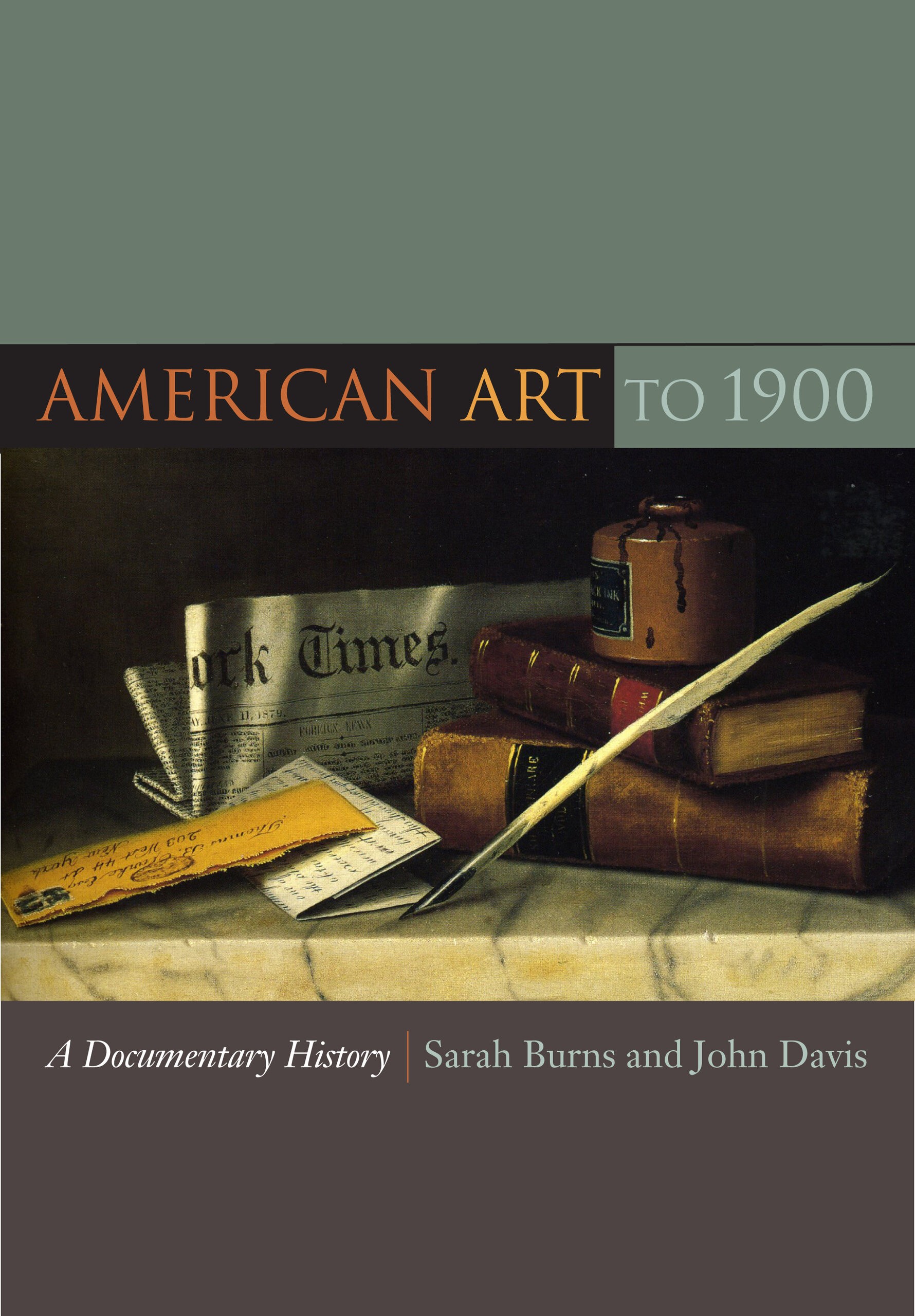
About the Book
From the simple assertion that "words matter" in the study of visual art, this comprehensive but eminently readable volume gathers an extraordinary selection of words—painters and sculptors writing in their diaries, critics responding to a sensational exhibition, groups of artists issuing stylistic manifestos, and poets reflecting on particular works of art. Along with a broad array of canonical texts, Sarah Burns and John Davis have assembled an astonishing variety of unknown, little known, or undervalued documents to convey the story of American art through the many voices of its contemporary practitioners, consumers, and commentators. American Art to 1900 highlights such critically important themes as women artists, African American representation and expression, regional and itinerant artists, Native Americans and the frontier, popular culture and vernacular imagery, institutional history, and more. With its hundreds of explanatory headnotes providing essential context and guidance to readers, this book reveals the documentary riches of American art and its many intersecting histories in unprecedented breadth, depth, and detail.
Table of Contents
Introduction
1. THE COLONIAL ERA
Art in an age of puritanism
The Well-Dressed Puritan
Icons and the Metaphor of Painting
Cotton Mather on Art
Thomas Smith’s Reflection on Death
Dissenting opinions: alternatives to puritan practice
Quaker “Rules” on Tombstones
John Valentine Haidt’s Theory of Painting
Art and the Spanish Conquest
Advertisements
Peter Pelham Scrapes a Mezzotint
Runaway “Limners”
John Durand
Work forWomen
Public Spectacle
Early responses to portraits
Pioneering artists
John Smibert Documents
BenjaminWest onWilliamWilliams
Taste and theory
Of the Knowledge of Painting
The Use and Advantages of the Fine Arts
Poems on portraits
Training and the lure of europe
John Singleton Copley: Ambition and Practicality
CharlesWillson Peale in London and Philadelphia
2. REVOLUTION AND EARLY REPUBLIC
Defining art
John Adams on the Arts
Public Art for the New Republic: Charles Willson Peale’s
Triumphal Arch
The Place of the Arts in American Society
An Early Scheme for a Museum of Sculpture
Sculptors for the Capitol
Wertmüller’s Danaë and “Nudities”
“Native” Subjects vs. Continental Taste
A Plan for Government Patronage of History Painting
Citizens: documents on portrait painting
Bushrod Washington Commissions a Portrait
GeorgeWashington: The Image Industry
Ralph Earl and Reuben Moulthrop: Connecticut Itinerant Painters
Joshua Johnson Advertises
Gilbert Stuart: Eyewitness Accounts
President Monroe Discusses American Artists
Charles Willson Peale’s Advice to Rembrandt Peale
Chester Harding: Self-Made Artist
Artistic identity, artistic choices
Benjamin West: A NewWorld Genius Conquers the Old
Benjamin West, Patriarch of American Painting
John Trumbull Paints Revolutionary History
Washington Allston’s Southern Roots
Washington Allston and the Miraculous Sublime
Washington Allston in Boston
Washington Allston’s “Secret Technique”
Washington Allston’s Idealism
John Vanderlyn’s Bid for Fame
John Vanderlyn Paints an American Epic
John Vanderlyn’s Panorama
Samuel Morse’s The House of Representatives
Rembrandt Peale’s The Court of Death
The establishment of artistic categories
Landscape
Charles Willson Peale’s Moving Pictures
Timothy Dwight Views Greenfield Hill
The American Gothic Landscapes of Charles Brockden Brown
The Earliest Guide to Sketching Landscape
Still Life: Raphaelle Peale
Genre: John Lewis Krimmel
Early institutions
Philadelphia
Charles Willson Peale’s Museum
The Columbianum
Quaker City Arts Organizations, c. 1810
New York: The American Academy of the Fine Arts
Boston: John Browere’s Gallery
3. ANTEBELLUM AMERICA: VALUES AND INSTITUTIONS
Art in a democratic nation
The Importance of the Genres
Art in a Mercantile Culture
Charles Fraser Considers Art, Society, and the Future
William Dunlap Champions the Arts
Ralph Waldo Emerson’s Living Art
The Anti–”American School”
Joel HeadleyWaves the Flag of American Art
On Mechanics and the Useful Arts
Building institutions
The National Academy of Design
The Founding
The Early Years
Growing Polarization
The American Art-Union
Collectors and patrons
Thomas Cole and His Patrons
Thomas Cole Laments the Taste of the Times
William Sidney Mount Chooses a Subject
Instructions for Collectors
James Fenimore Cooper Commissions a Statue
Art and Private Property
4. ANTEBELLUM AMERICA: LANDSCAPE, LIFE, AND SPECTACLE
The american landscape
Literary Landscapes
James Fenimore Cooper’s Forest Primeval
Educating the Gaze: Benjamin Silliman on Monte Video
The Glory of an American Autumn
Romantic Nature
For the Birds: John James Audubon and American Nature
Thomas Cole and the American Landscape
The Poetry of Landscape: Thomas Cole in Verse
Thomas Cole and the Course of Empire
American Sites: Tourist Literature
Tourists in the Landscape
The Railroad in the Landscape
Transcendental Nature
Emerson’s Transcendent Natural World
Nature, Wild and Tame
Asher B. Durand Formulates the American Landscape
The Hudson River School in Public
Facing Nature: Jasper Cropsey and Sanford Gifford
The National Landscape in Repose: John Frederick Kensett
Fitz Henry Lane, Marine Painter Extraordinary
American life
Ralph Waldo Emerson on Native and National Art
William Sidney Mount and the Celebration of National Character
William Sidney Mount’s Thoughts on Art, Life, and Travel Abroad
The Significance of Bumps on the Skull
Walt Whitman on American Painting
David Gilmour Blythe on Modern Times
Lilly Martin Spencer: Making It in New York
Artists of color and the representation of race
The Public Display of Slavery
William Sidney Mount’s Ambivalence on Race
Frederick Douglass on African American Portraiture
The Verses of Dave the Potter
J.P. Ball’s Panorama of Slavery
An Imaginary Picture Gallery
Eastman Johnson’s Negro Life at the South
Artists: advice and careers
Rufus Porter’s Recipe for Mural Painting
Thomas Seir Cummings on Miniature Painting
A Folk Artist Overcomes a Disability
Thomas Sully’s Hints to Young Painters
5. ANTEBELLUM AMERICA: PUBLIC ART AND POPULAR ART
The U.S. government as patron: decoration of the capitol
Horatio Greenough’s George Washington
Lobbying for Capitol Commissions
The Liberty Cap as a Symbol of Slavery
Artists Weigh In on Art in the Capitol
Art in public
Hiram Powers’s The Greek Slave
The Public Display of the Nude
George Templeton Strong Visits the National Academy
Too Many Portraits?
Henry James Remembers a New York Childhood
Popular art, edification, and entertainment
Responses to the Daguerreotype
Taste and Print Culture
Daniel Huntington’s Mercy’s Dream
Gift Books and Sentimental Culture
High and Low: Taste in Painting
Currier & Ives: Art Hand in Hand with Business
OliverWendell Holmes on Stereographs
The American Museum
6. ANTEBELLUM AMERICA: EXPANDING HORIZONS
International travel and exchange
Düsseldorf and the Düsseldorf Gallery
The Lure of Italy
Manifest destiny
Manufacturing history
American History, Pro and Con
The American Spirit of Emanuel Leutze
Emanuel Leutze’s Clash of Civilizations
Washington Crosses the Delaware: Birth of an Icon
Art on and of the frontier
The Noble Savage/Vanishing Race
George Catlin Portrays the Native Americans
Prince Max and Karl Bodmer among the Mandan
American Indians as Spectacle
American Indians as Pictorial Material
Western Life
George Caleb Bingham:Western Life andWestern Politics
Critics on Bingham, East andWest
Life on the Mississippi in John Banvard’s Panorama
William Jewett’s Letters from California
Frederic church’s sublime landscapes
Heart of the Andes
After Icebergs with a Painter
7. THE 1860s
Taking stock
The Photograph and the Face
A Sunny View of American Progress in Art
James Jackson Jarves’s The Art-Idea
Henry T. Tuckerman’s Book of the Artists
Sculpture in Mid-century America
Landscape at a crossroads: nature seen through telescope and microscope
The American Pre-Raphaelites
Albert Bierstadt’s Great Picture
Variations on a Scene: John Frederick Kensett, Albert Bierstadt, and Thomas Hill
Too Many Landscapes
Civil war
The War and the Artist
A Southern View of the Arts duringWar
Photographs of Antietam
Sanitary Fairs
History Painting and theWar
Winslow Homer’s Prisoners from the Front
Race
Sojourner Truth Inspires a Sculptor
John Quincy AdamsWard’s Freedman
AnneWhitney’s Africa
Postwar Painting and Race
Art after conflict
Memorializing theWar
The National Academy of Design: Praise and Condemnation
Settling In: Artists in Their Studios
The Conditions of Art in America
Dissatisfaction with Artists
What Does Art Teach Us?
Is Religious Art Still Relevant?
8. THE GILDED AGE: LIFE AND LANDSCAPE AT HOME
Nationalism and home subjects
Eugene Benson’s French Gospel for Truly American Art
Home Subjects and Patriotic Painting
Eastman Johnson’s Formula for Success
Art in the South
Modes of realism
Winslow Homer, All-American
Damnable Ugly: Henry James on Homer
Winslow Homer’s Working Methods
Winslow Homer’s Sea Change
Winslow Homer’s Savage Nature and Primal Scenes
Thomas Eakins in Europe
Thomas Eakins’s The Gross Clinic
Mariana Griswold Van Rensselaer Meets Thomas Eakins
Eadweard Muybridge’s Serial Photographs
Race and representation
Robert Duncanson and “Passing”
Edward Bannister and George Bickles:
Discrimination and Acceptance
Winslow Homer: Painting Race
Henry Ossawa Tanner
Landscapes: east and west
The Old Northeast
Armchair Tourism and Picturesque America
Poetry in Paint: Art in Boston
George Inness and the Spiritual in Art
George Inness and the Landscape of the Mind
The New West
William Henry Jackson: Photographing theWest
Thomas Moran and theWestern Sublime
Frederic Remington’sWildWest
Cultural Intersections: Native Art and theWhite Imperial Gaze
9. THE GILDED AGE: ART WORLDS AND ART MARKETS
Art on the market
French Art in New York
Buy American
Art as Commodity
Artists Broker TheirWork
American Artists: Starving or Selling Out
ArtWorld Diaries: Jervis McEntee and J. Carroll Beckwith
Studio life and art society
New Men andWomen in New York
Artists and Models
William Merritt Chase’s Super-Studio
Elizabeth Bisland Roving the Studios
The Tile Club: Play asWork
Artists in Their Summer Havens
Varnishing Day
10. THE GILDED AGE: EDUCATION, INSTITUTIONS, AND EXHIBITIONS
Education
A Cautionary Essay on Art Instruction
Boston
William Morris Hunt’s Talks on Art
The Massachusetts Drawing Act of 1870
Chicago
Sculpture at the Art Institute of Chicago
New York
Labor and Art on the Lower East Side
LemuelWilmarth on the Life Class
Breaking Away: The Art Students League
Philadelphia
The School of the Pennsylvania Academy of the Fine Arts
The Pennsylvania Museum and School of Industrial Art
San Francisco
A Deaf Artist in San Francisco
Art institutions
Young Turks: The Formation of the Society of American Artists
The Need for American Museums
George Inness on Art Organizations
The philadelphia centennial and the colonial revival
E. L. Henry Dreams of the Past
The Centennial Exhibition
The Colonial Revival Landscape
11. COSMOPOLITAN DIALOGUES
Internationalism
The Tariff Controversy
Internationalist Backlash
The Return from Europe
Friedrich Pecht: A German Critic on American Art
Americans Abroad
Art education
Germany
The Munich School
France
Will Low Remembers Barbizon
J. AldenWeirWrites Home about Jean-Léon Gérôme
Elizabeth Boott Studies with Thomas Couture
Kenyon Cox Struggles in Paris
May Alcott Nieriker’s Tips for Study in Paris
Student Life at the Ecole des Beaux-Arts
A Midwesterner in the City of Light
The nude
Kenyon Cox’s Lonely Campaign for the Nude
Anthony Comstock vs. Knoedler & Co.
Augustus Saint-Gaudens Resigns
Arch-expatriates
James McNeillWhistler, Expatriate Extraordinaire
Art on Trial: James McNeillWhistler vs. John Ruskin
James McNeillWhistler’s Platform
James McNeillWhistler and the Critics
John Singer Sargent, Man of theWorld
New women in art
Women Sculptors in the Eternal City
A Feminist Looks at Harriet Hosmer
Women Artists,Woman’s Sphere
Mary Cassatt, ModernWoman
Cecilia Beaux: Becoming the GreatestWoman Painter
ShouldWomen Artists Marry?
The ArtWorkers’ Club forWomen
Advice forWomen Photographers
12. NEW MEDIA, NEW TASTEMAKERS, NEW MASSES
Critical voices
Eugene Benson
Earl Shinn on Criticism
Mariana Griswold Van Rensselaer Assesses
the Progress of American Art
Sylvester Koehler Reflects on a Decade of American Art
William Howe Downes and Frank Torrey Robinson’s
“Critical Conversations”
The little media
Watercolor
The American Taste forWatercolor
A Child’s View of theWatercolor Show
Pastel
The Society of American Painters in Pastel
JamesWells Champney on Pastels
Etching
The “First” American Etching
Two Views on Etching
Women Etchers: Mary Nimmo Moran
Otto Bacher onWhistler in Venice
Wood Engraving
Popular art and its critique
The Nation vs. Prang & Co.
John Rogers, the People’s Sculptor
The Trouble with Monuments
William Harnett’s After the Hunt and The Old Violin
The Gap between Professionals and the Public
John George Brown, the Public’s Favorite
In the magazines: the new illustrators
In Defense of Illustration
Howard Pyle’s Credo
Charles Dana Gibson, All-American Illustrator
Women in Illustration
amateur or artist? debates on photography
Amateurs
Pictorialism
13. BEAUTY, VISION, AND MODERNITY
The aesthetic movement
OscarWilde’s American Tour
Advice to Decorators
Poking Fun at Aestheticism
Aesthetic and IndustriousWomen
Japonisme
John La Farge’s Revolution in Stained Glass
Impressionism: critical reception
American Artists Confront Impressionism
French Impressionism Comes to America
Impressionism: american practices
The Americanization of Impressionism
William Merritt Chase, Seeing Machine
Childe Hassam on Painting Street Scenes
Impressionism: eclectic practices
Genealogies of Tonalism
Thomas Wilmer Dewing, Choice Spirit
Praise for John Twachtman
Refinement in Boston: Edmund Tarbell
The Sensuous Color of John La Farge
Art colonies
Summer Colonies
Vacationing with Art in Shinnecock Hills
Living the Life of Art in Cornish
Beyond the threshold: visionaries and dreamers
William Rimmer: Angels and Demons
Elihu Vedder, Mystical Joker
Albert Pinkham Ryder: The Myth of the Romantic Primitive
14. IMPERIAL AMERICA
The world’s columbian exposition
Experiencing the Fair
Popular Art at the Fair
Mural painting
Edwin Howland Blashfield Defines Mural Painting
Kenyon Cox Negotiates a Commission
Public sculpture
The Farragut Monument
The National Sculpture Society
Karl Bitter on Sculpture for the City
A Victory Monument over Fifth Avenue
Retrospectives and prospects
California vs. the East Coast
The Clarke Sale Cements the Value of American Art
American Art Poised for a New Century
Surveying the Century: Samuel Isham and Charles Caffin
Acknowledgments
List of Illustrations
Index