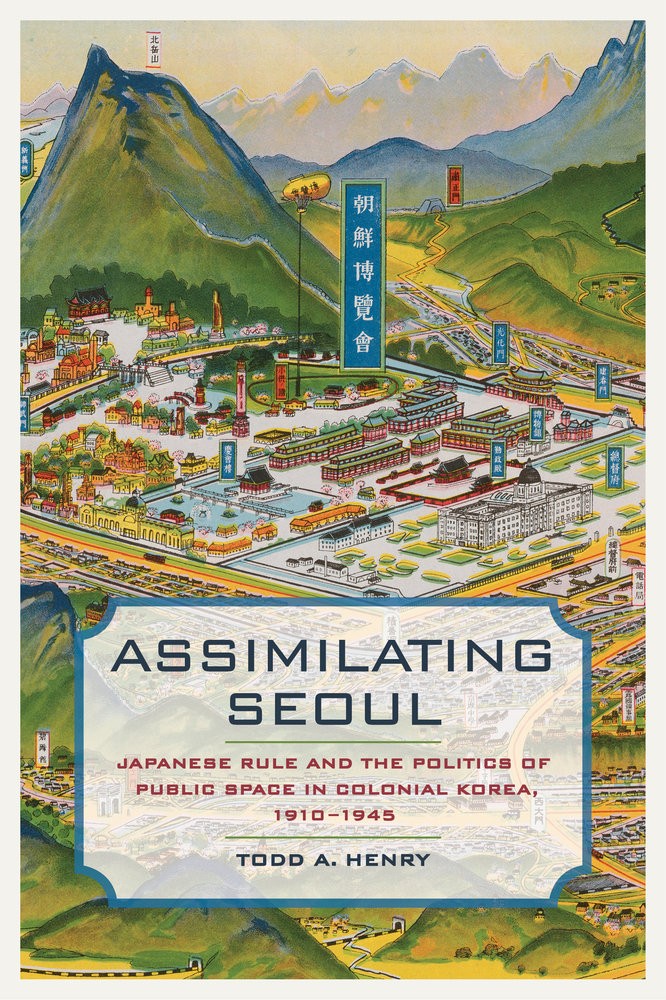
"A detailed study of Korean and Japanese identity and adaptability in the colonial setting... Assimilating Seoul will be required reading for anyone studying the Japanese colonial period in Korea, for scholars of colonialism in general, and for students wanting to look beyond purely nationalist narratives for understandings of the past."
"A new and insightful perspective."
"Henry does an excellent job . . . Highly recommended."
"Assimilating Seoul provides a nuanced view of Japan’s colonial endeavor in Korea. . . . A respectable contribution."
"Bold and ambitious . . . A timely and provocative study."
"An important test case showing the potential validity and effectiveness of employing sociocultural-based case study methods in explorations of urban colonial society as a way to overcome the limitations of political historical approaches to the past."
"Assimilating Seoul provides a wealth of information and brims with fresh insights... Henry's adept probe into the city's physical and conceptual ambits is remarkably perceptive."
"Beautifully written... The reader can feel the author’s genuine passion for understanding the people of whom he writes. Assimilating Seoul is essential reading for all students of twentieth-century Korean society. Directed as much at engaging historians based in South Korea as those elsewhere, the book is bound to spur debate."
"As a pioneering work on an important subject so far glaringly under-researched outside of South Korea and Japan, it enriches the scholarship on Korean history in English. . . Henry’s book represents first-rate, pioneering scholarship."
"Moving beyond top-down accounts of colonialism, Assimilating Seoul offers a richly textured, on-the-ground understanding of how Japanese rule operated and was contested in Seoul. The book’s careful and vivid reconstruction of the entanglements of the state with city residents makes the powerful argument that the materiality of colonial power should be understood in the configuration and experiences of urban spaces. It is a splendid combination of urban and colonial histories." —Gyan Prakash, author of Mumbai Fables
"In this illuminating examination of spatial politics in Japanese-occupied Seoul, Todd Henry takes us into the labyrinth of colonial governmentality. His captivating analysis of public ritual, city planning, and industrial expositions reveals the varied uses of urban form as a technology of rule--as well as the limitations of state power. A model study of the colonial city."—Louise Young, author of Beyond the Metropolis: Second Cities and Modern Life in Interwar Japan
"Few issues in the history of world colonialism are as conceptually challenging as the problem of assimilation within the Japanese empire. Henry offers a fascinating approach to the contentious politics of what it meant to be a Korean colonial subject under Japanese rule. The many answers to this problem are sure to stimulate debate."—Andre Schmid, Professor of East Asian Studies, University of Toronto
"This is one of the best books on modern Korean history I've read in recent years. Henry breaks new ground, especially in English, in his focus on the 'spaces' of colonial rule, and his command of such rich and varied primary sources is impressive. Assimilating Seoul is a fascinating read."—Carter J. Eckert, Yoon Se Young Professor of Korean History, Harvard University