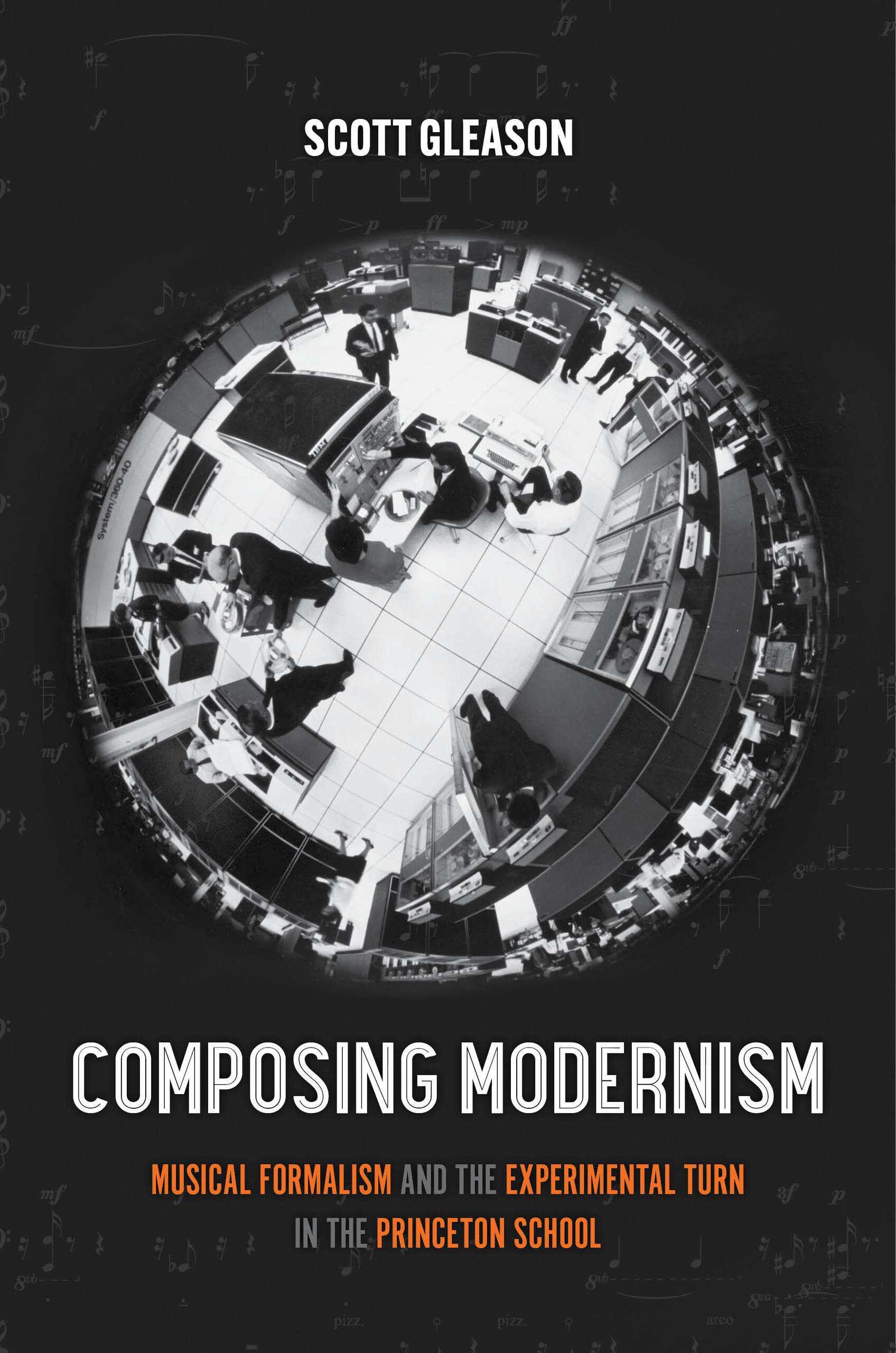
“‘In the Princeton School,’ Scott Gleason writes, ‘we find an intellectual audacity which leads to a certain strangeness.’ Ah, reader, just wait! Gleason not only provides the authoritative account of one of the wildest, weirdest episodes in twentieth-century music but also reveals a lost country in which, for a few decades, institution and freedom produced the rarest crucible of hope and play. This is history at its most meaningful: a vision for the future of what now seems impossible.”—Seth Brodsky, author of From 1989, or European Music and the Modernist Unconscious
“Gleason’s rigorous yet imaginative (and loving) historiography supports his audacious claim that the Princeton School ushered in both Cold War high modernism in the United States and the hybrid figure of the composer-theorist. He recuperates the compositional ambitions of the diverse personae involved, situating specific compositional practices within social, political, technological, philosophical, and aesthetic thematics while underscoring the role theory was meant to play in what we can now call their artistic-research endeavors: always as a means to grow and nurture creative practice, always, in the end, as liberatory.”—Chris Stover, author of Reimagining Music Theory: Contexts, Communities, Creativities
“In lucid prose, Gleason demonstrates how the Princeton School created the archetype of the composer-theorist and thereby a distinctive manifestation of musical modernism and musical academia. The picture that emerges depicts a group that was more diverse and complex than both its proponents and its detractors typically acknowledge. Composing Modernism combines superb scholarship, outstanding critical insight, and acute judgment, all in exemplary fashion.”—Björn Heile, Professor of Music, University of Glasgow
“An extraordinarily penetrating and richly contextualized account of the Princeton School, a group of composer-theorists associated with Princeton University and gathered around the central figure of Milton Babbitt. By delving so deeply into a single slice of American modernist music since World War II, Gleason sheds surprising light on the larger modernist scene. This is a significant work of intellectual history.”—Joseph N. Straus, author of Broken Beauty: Musical Modernism and the Representation of Disability