University of California Press
Publishing Services

Domesticated Deities and Auspicious Emblems

The Iconography of Everyday Life in Village China

by Sung-Nien Po (Author), David Johnson (Author)
Price: $25.00 / £21.00
Publication Date: Jan 1992
Publisher:
Institute of East Asian Studies, University of California Berkeley
Imprint: Institute of East Asian Studies, University of California Berkeley
Title Details:
Rights: World
Pages: 210
ISBN: 9780962432712
Trim Size: 8.5 x 11
Illustrations: color throughout
Series:
  • Chinese Popular Culture Project

About the Book

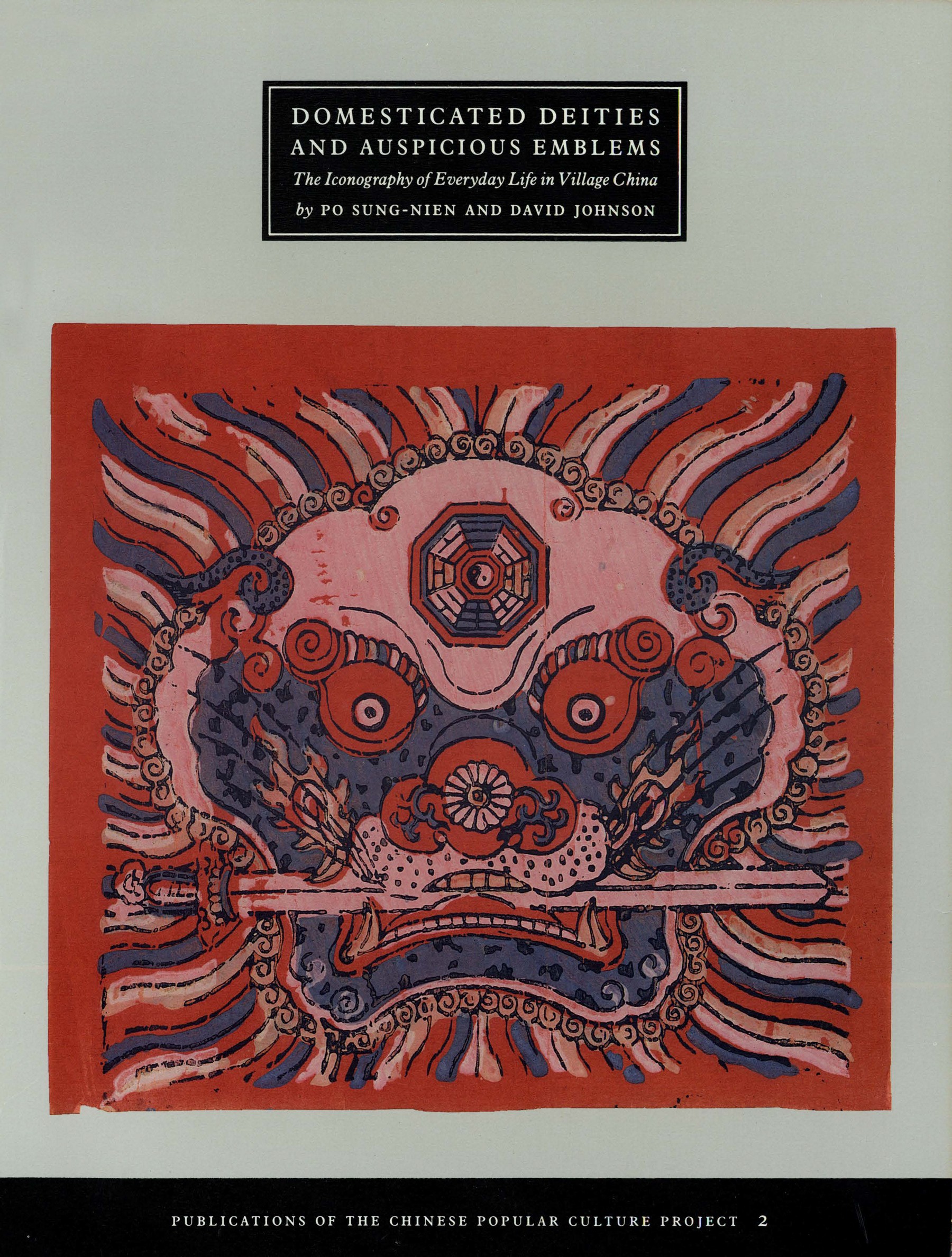
This is the exhibition catalog of a show held at the Graduate Theological Union in Berkeley in 1991 as the culmination of the Chinese Popular Culture Project. This volume studies the popular values and beliefs of ordinary people in China through the colorful representational imagery of gods and demigods, heroes and heroines, plump babies and bearded sages, and auspicious symbols depicted on woodblock prints and papercuts. Collected by Po Sung-nien over the last forty years, these examples of folk art are a valuable source for the reconstruction of popular mentalities in premodern China. This books serves as a valuable primer of Chinese popular iconography.

About the Author

Po Sung-nien (Bo Songnian ???) is a former graduate and current member of the faculty at the Central Academy of Fine Arts, Beijing. He was the Chinese Popular Culture Project's Senior Residential Fellow in 1990-1991, when he curated the exhibition Domesticated Deities and Auspicious Emblems from his personal collection. He is the author of several Chinese-language books of the history of painting in China and the history of New Year's prints.

David G. Johnson is professor emeritus of history at the University of California, Berkeley. His research interests include premodern China and traditional Chinese popular culture. He is the co-author of Domesticated Deities and Auspicious Emblems (IEAS, 1992) and the author of Spectacle and Sacrifice: The Ritual Foundations of Village Life in North China (Harvard University Press, 2010).
Education: A.B. at Harvard College; Ph.D. at the University of California, Berkeley

Table of Contents

Preface—7

Introduction—9

Explanatory Note—19

Iconic Prints: The Gods of the Chinese Peasant Family

The Stove God—23

The Gods of Wealth—60

Other Gods—66

Pantheons and Ancestors—84

Buddhist Deities—96

Mimetic Prints and Papercuts

Door Gods and Door Prints—105

Chung K'uei—136

Auspicious Prints—148

Instructive Prints—162

Opera Prints—171

The Mouse's Wedding—181

Papercuts—191

Select Bibliography—205

Glossary—206

Reviews

"In this book, [Po Sung-nien] surveys the history of the New Year print from its earliest antecedents (such as paintings of door gods on the gates of graves), through the traditional print itself until the modern communist propaganda poster. He deals mainly with the New Year print as an independent artistic genre, devoting the most attention to the handicraft dimension of the prints."—B.J. Ter Haar, Leiden University, T'oung Pao, Second Series, Vol. 80, Fasc. 4/5 (1994): 433-438

"This is a lovely and instructive volume. I wish only that it did not mark one of the last activities of a fine project."—Stephan Feuchtwang, City University, Asian Folklore Studies 53. no. 1 (1994): 180-182

"The book is a wonderful resource for the student of Chinese cultural history, for it provides a close reading of a wealth of familiar everyday life symbols....The authors also give us a good sense of the spread of woodblock prints in China by pointing out their provenances and by naming their printmaking shops."—Chang-tai Hung, Carleton College, The Journal of Asian Studies 52, no. 4 (Nov. 1993): 987-989