University of California Press
Publishing Services

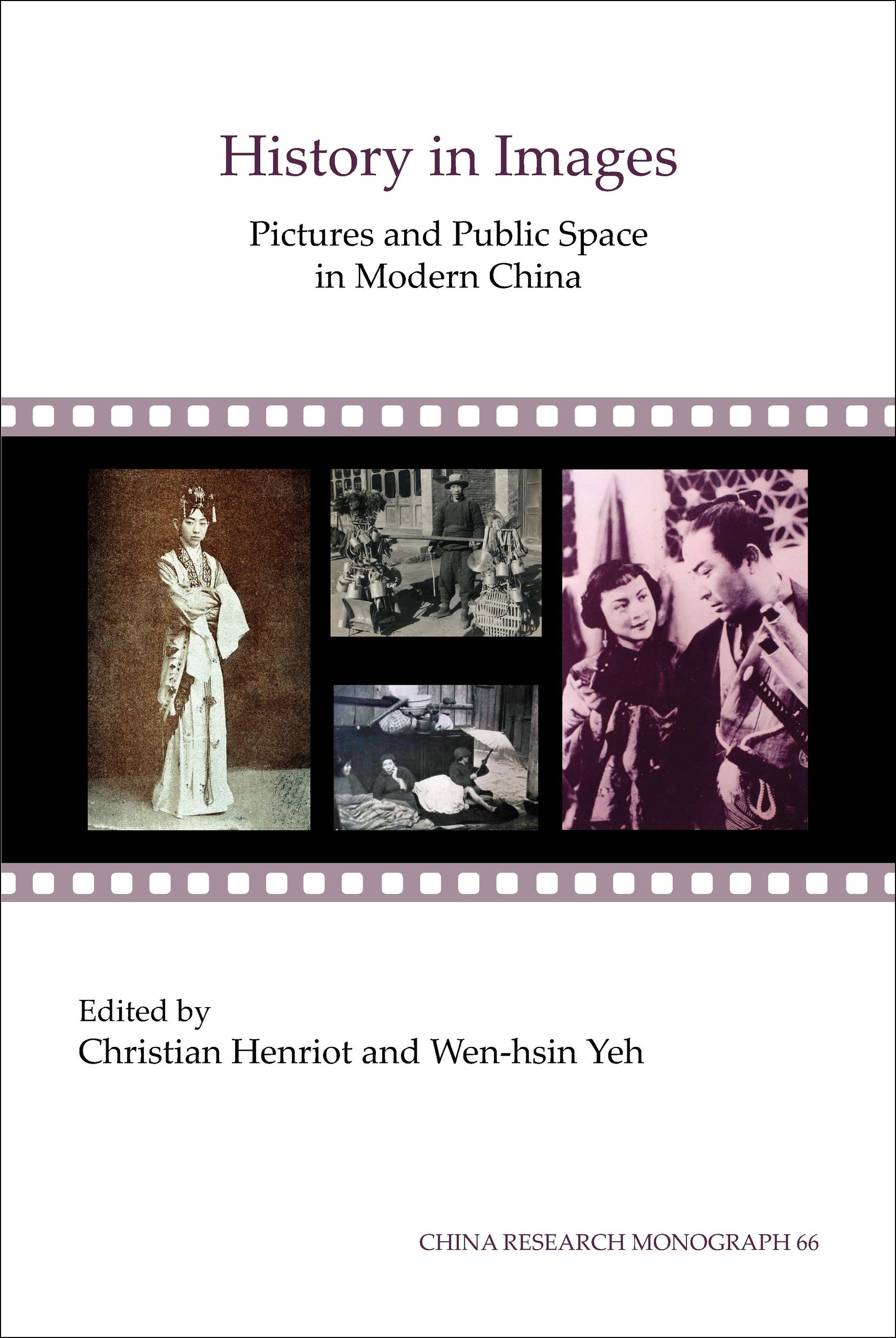
History in Images

Pictures and Public Space in Modern China

by Christian Henriot (Editor), Wen-hsin Yeh (Editor)
Price: $32.00 / £27.00
Publication Date: May 2012
Publisher:
Institute of East Asian Studies, University of California Berkeley
Imprint: Institute of East Asian Studies, University of California Berkeley
Title Details:
Rights: World
Pages: 284
ISBN: 9781557291011
Trim Size: 6 x 9
Series:
  • China Research Monograph

About the Book

The essays in this volume are organized into two groups: those that consider the use of historical photographs and those that examine the practices of Chinese cinema. They represent a preliminary effort to examine pictorial products and public communications of China’s modern period. Drawing on a considerable range of empirical sources, the authors of these essays take up the methodological challenge of pictorial materials for the study of history. The diverse approaches offer a spectrum of methodological possibilities with regard to the use of images in history.

About the Author

Christian Henriot is professor of modern Chinese history at the University of Lyon. He specializes in the urban and social history of China, as well as the history of Sino-Japanese conflict. He is the co-founder of the European Journal of East Asian Studies and co-editor of History in Images: Pictures and Public Space in Modern China (IEAS, 2012). Education: M.A., History, Stanford University; Ph.D., New Sorbonne University; State Doctorate, École des hautes études en sciences sociales (EHESS)

Wen-hsin Yeh is professor of history at the University of California, Berkeley. She has served as the director of the Institute of East Asian Studies and the chair of the Center for Chinese Studies at Berkeley. She has edited and contributed to many IEAS publications, including Mobile Subjects; Mobile Horizons; History in Images; Cities in Motion; Empire, Nation, and Beyond; Cross-Cultural Readings of Chineseness; Landscape, Culture, and Space in Chinese Society; and Shanghai Sojourners. Education: B.A., History, National Taiwan University; M.A., History, University of Southern California; Ph.D., History, University of California, Berkeley

Table of Contents

1. Introduction – 1

    Christian Henriot and Wen-hsin Yeh
 

2. Wartime Shanghai Refugees: Chaos, Exclusion, and Indignity. Do Images Make up for the Absence of Memory? – 12

    Christian Henriot
 

3. Sha Fei, the Jin-Cha-Ji Pictorial, and the Documentary Style of Chinese Wartime Photojournalism – 55

    Shana J. Brown
 

4. China, a Man in the Guise of an Upright Female: Photography, the Art of the Hands, and Mei Lanfang's 1930 Visit to the United States – 81

    Catherine Yeh
 

5. The Sound of Images: Peddlers’ Calls and Tunes in Republican Peking – 111

    Feng Yi
 

6. Never-Ending Controversies: The Case of Chun jiang yi hen and Occupation-Era Chinese Filmmaking – 143

    Paul G. Pickowicz
 

7. ""The Enemy Is Coming"": The 28 January 1932 Attack on Shanghai in Chinese Cinema – 163

    Anne Kerlan
 

8. Two Stars on the Silver Screen: The Metafilm as Chinese Modern – 191

    Kristine Harris
 

9. Alternative History, Alternative Memory: Cinematic Representation of the Three Gorges in the Shadow of the Dam – 245

    Sheldon H. Lu
 

Index – 259

Reviews

"This is an extremely interesting and useful collection of essays presenting totally new interpretations of images in photography and cinema in twentieth-century China. Essays herein demonstrate how, with proper analysis, significant information about material culture can be obtained from visual images. These essays in particular validate the notion that visual images are discrete sources of information and should not be relegated to mere illustrations to a written text."—Ellen Johnston Laing, University of Michigan

"As I read the manuscript, I thought, 'If a picture is worth a thousand words, these words about pictures are also highly illuminating. Bringing attention to the visual within history and as a means of thinking about history adds a fresh and artful dimension to the study of Republican China.' Indeed, there is much to learn and to think with in the chapters that make up this volume."—Timothy B. Weston, University of Colorado at Boulder

"This volume raises an important question that has not been addressed systematically be scholars: how can historians utilize more productively visual images produced through modern technologies, specifically, photographs and movies? Many chapters in this volume make laudable efforts to examine the nature of such materials and their benefits and limitations for historical research; their reflections on the methodologies historians can adopt to utilize such materials will be helpful to many in the field."—Madeleine Yue Dong, University of Washington