University of California Press

About the Book

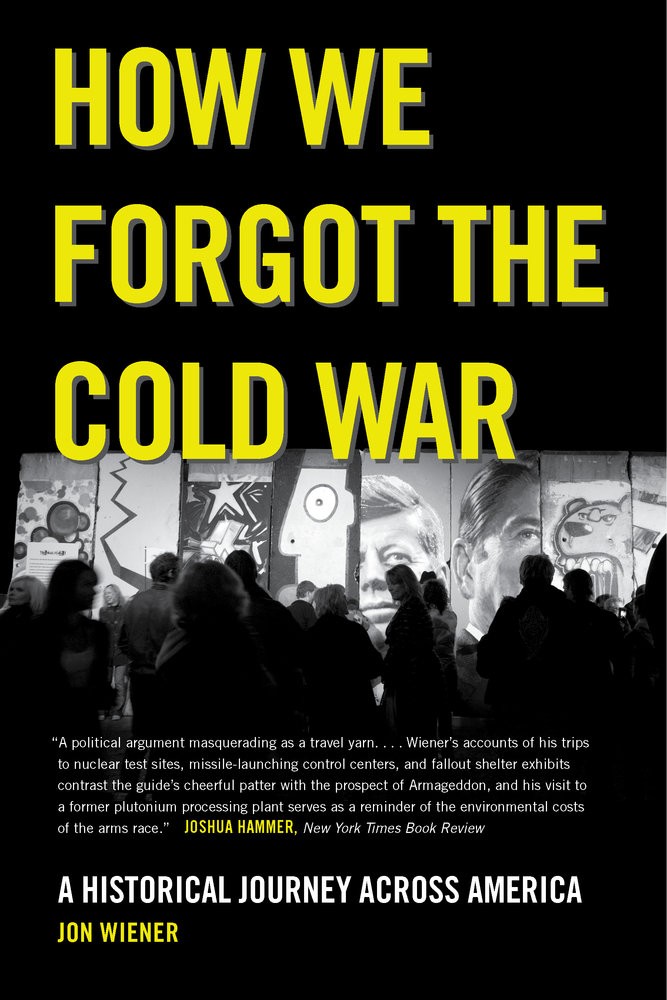
Hours after the USSR collapsed in 1991, Congress began making plans to establish the official memory of the Cold War. Conservatives dominated the proceedings, spending millions to portray the conflict as a triumph of good over evil and a defeat of totalitarianism equal in significance to World War II. In this provocative book, historian Jon Wiener visits Cold War monuments, museums, and memorials across the United States to find out how the era is being remembered. The author’s journey provides a history of the Cold War, one that turns many conventional notions on their heads.

In an engaging travelogue that takes readers to sites such as the life-size recreation of Berlin’s “Checkpoint Charlie” at the Reagan Library, the fallout shelter display at the Smithsonian, and exhibits about “Sgt. Elvis,” America’s most famous Cold War veteran, Wiener discovers that the Cold War isn’t being remembered. It’s being forgotten. Despite an immense effort, the conservatives’ monuments weren’t built, their historic sites have few visitors, and many of their museums have now shifted focus to other topics. Proponents of the notion of a heroic “Cold War victory” failed; the public didn’t buy the official story. Lively, readable, and well-informed, this book expands current discussions about memory and history, and raises intriguing questions about popular skepticism toward official ideology.

About the Author

Jon Wiener is Professor of History at the University of California, Irvine. Among his books are Gimme Some Truth: The John Lennon FBI Files (UC Press) and Historians in Trouble: Plagiarism, Fraud and Politics in the Ivory Tower.

Table of Contents

List of Illustrations
Introduction: Forgetting the Cold War

Part One. The End
1. Hippie Day at the Reagan Library
2. The Victims of Communism Museum: A Study in Failure

Part Two. The Beginning: 1946–1949
3. Getting Started: The Churchill Memorial in Missouri
4. Searching for the Pumpkin Patch: The Whittaker Chambers National Historic Landmark
5. Naming Names, from Laramie to Beverly Hills
6. Secrets on Display: The CIA Museum and the NSA Museum
7. Cold War Cleanup: The Hanford Tour

Part Three. The 1950s
8. Test Site Tourism in Nevada
9. Memorial Day in Lakewood and La Jolla: Korean War Monuments of California
10. Code Name “Ethel”: The Rosenbergs in the Museums
11. Mound Builders of Missouri: Nuclear Waste at Weldon Spring
12. Cold War Elvis: Sgt. Presley at the General George Patton Museum

Part Four. The 1960s and After
13. The Graceland of Cold War Tourism: The Greenbrier Bunker
14. Ike’s Emmy: Monuments to the Military-Industrial Complex
15. The Fallout Shelters of North Dakota
16. “It Had to Do with Cuba and Missiles”: Thirteen Days in October
17. The Museum of the Missile Gap: Arizona’s Titan Missile Memorial
18. The Museum of Détente: The Nixon Library in Yorba Linda

Part Five. Alternative Approaches
19. Rocky Flats: Uncovering the Secrets
20. CNN’s Cold War: Equal Time for the Russians
21. Harry Truman’s Amazing Museum

Conclusion: History, Memory, and the Cold War
Epilogue: From the Cold War to the War in Iraq

Acknowledgments
Notes
Index

Reviews

“As popular reading, it's got the humor and wit of Sarah Vowell's Assassination Vacation and James Loewen's Sundown Towns and DJ Waldie's Holy Land. By which I mean it's witty and kinda mean, and exhilarating bad fun.”
Oc Weekly: Orange County News, Arts & Ent
“Wiener’s wit and deft grasp of geopolitics make for one of the season’s most intriguing historical books.”
Philadelphia City Paper
“Who knew the Cold War was funny? Wiener’s adventures in American historical memory are surprisingly lively.”
Zocalo Public Square
“A provocative and fascinating new book.”
Los Angeles Review Of Books
“A political argument masquerading as a travel yarn. . . . Wiener’s accounts of his trips to nuclear test sites, missile-launching control centers and fallout shelter exhibits contrast the guides’ cheerful patter with the prospect of Armageddon, and his visit to a former plutonium processing plant serves as a reminder of the environmental costs of the arms race. His journey ends at the Vietnam Veterans Memorial, which stands as a stark rebuttal to those who have glorified the proxy wars fought in the name of defeating Communism.”
New York Times Book Review
“A splendid tour de farce of the museums and other memory palaces established largely by the American right in honor of the greatest triumph in human history, the winning of the... oh, remind me, what was it?”
Tomdispatch
"A fascinating and insightful view of the past two decades and how the country has moved beyond the Cold War...or has not."
Communication Booknotes Quarterly
“The pleasure of this book comes not only from Wiener's keen analyses but from his having taken the tour bus, showed up at Lakewood, California, Memorial Day festivities (and speeches), looked and listened to what guides (printed, spoken aloud, and on CD) had to say, and generally speaking put up with things that drive most of us quickly toward boredom and departure. He rewards himself with the iconoclast's fun along the way, a good deal of it dark humor.”
Swans.com
"Wiener is a sharp observer."
American Historical Review
“Here’s a book that would've split the sides of Thucydides. Wiener’s magical mystery tour of Cold War museums is simultaneously hilarious and the best thing ever written on public history and its contestation.“ —Mike Davis, author of City of Quartz


“Jon Wiener, an astute observer of how history is perceived by the general public, shows us how official efforts to shape popular memory of the Cold War have failed. His journey across America to visit exhibits, monuments, and other historical sites, demonstrates how quickly the Cold War has faded from popular consciousness. A fascinating and entertaining book.” —Eric Foner, author of Reconstruction: America's Unfinished Revolution, 1863–1877


"In How We Forgot the Cold War, Jon Wiener shows how conservatives tried—and failed—to commemorate the Cold War as a noble victory over the global forces of tyranny, a 'good war' akin to World War II. Displaying splendid skills as a reporter in addition to his discerning eye as a scholar, this historian's travelogue convincingly shows how the right sought to extend its preferred policy of 'rollback' to the arena of public memory. In a country where historical memory has become an obsession, Wiener’s ability to document the ambiguities and absences in these commemorations is an unusual accomplishment.” —Rick Perlstein, author of Nixonland: The Rise of a President and the Fracturing of America


“In this terrific piece of scholarly journalism, Jon Wiener imaginatively combines scholarship on the Cold War, contemporary journalism, and his own observations of various sites commemorating the era to describe both what they contain and, just as importantly, what they do not. By interrogating the standard conservative brand of American triumphalism, Wiener offers an interpretation of the Cold War that emphasizes just how unnecessary the conflict was and how deleterious its aftereffects have really been.”—Ellen Schrecker, author of Many Are The Crimes: McCarthyism in America