University of California Press

About the Book

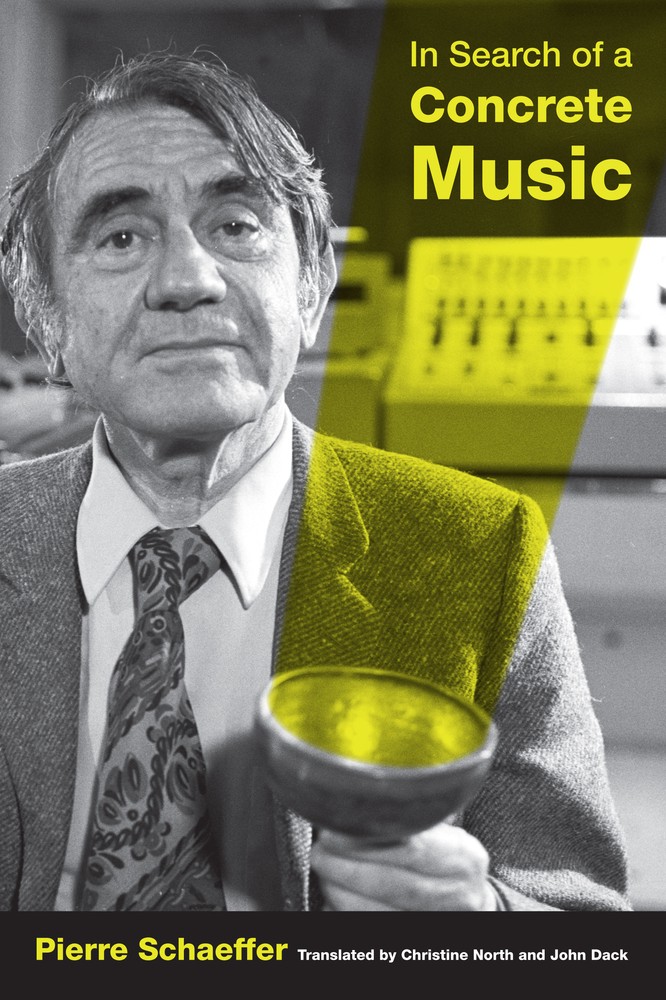
Pierre Schaeffer’s In Search of a Concrete Music (À la recherche d’une musique concrète) has long been considered a classic text in electroacoustic music and sound recording. Now Schaeffer’s pioneering work—at once a journal of his experiments in sound composition and a treatise on the raison d’être of “concrete music”—is available for the first time in English translation. Schaeffer’s theories have had a profound influence on composers working with technology. However, they extend beyond the confines of the studio and are applicable to many areas of contemporary musical thought, such as defining an ‘instrument’ and classifying sounds. Schaeffer has also become increasingly relevant to DJs and hip-hop producers as well as sound-based media artists. This unique book is essential for anyone interested in contemporary musicology or media history.

About the Author

Composer Pierre Schaeffer (1910–1995) was the inventor of musique concrète music created by combining and manipulating recorded sounds (rather than being played on conventional musical instruments).

Translators:
John Dack is Senior Research Fellow and Director of the Sonic Arts Department at Middlesex University. Christine North is retired as Lecturer in French at Middlesex University.

Table of Contents

Translators’ Note
I. First Journal of Concrete Music (1948–1949)
Chapter 1
Chapter 2
Chapter 3
Chapter 4
Chapter 5
Chapter 6
Chapter 7
II. Second Journal of Concrete Music (195–1951)
Chapter 8
Chapter 9
Chapter 1
Chapter 11
Chapter 12
Chapter 13
III. The Concrete Experiment in Music (1952)
Chapter 14. The Concrete Approach
Chapter 15. The Experimental Method
Chapter 16. The Musical Object
Chapter 17. From the Object to Language
Chapter 18. From the Object to the Subject
Chapter 19. Inventory
Chapter 2. Farewells to Concrete Music
IV. Outline of a Concrete Musical Training
Index

Reviews

“Collects Schaeffer’s journals and other writings about his musique concrete, which he created by manipulating recorded sounds.”
Harper’s
“One of the postwar perìod’s most significant (and readable) grapplings with new artistic paradigms.”
Frieze
“Completely changed how I hear the world and, after more than 30 years, I am still living with the consequences.”
The Wire
“One striking impression that emerges from reading this book is that [Schaeffer’s] work merits a perspective with greater nuance. Like most creators aware of the creative and conceptual restrictions of their historical location, we find Schaeffer time and again seeking a way to transcend them.”
Times Higher Education
“Schaeffer’s prose, translated masterfully by North and Dack, captures these uneven rhythms of intuition and perplexity, and his imagination and wit as he sets his observations not only against official and unofficial histories of music, but against contemporary art, poetry, and science.”
Los Angeles Review Of Books
“Recommended.”
Choice
"Few books have described with such precision the evolution of thoughts and concepts behind the invention of a new music as A La Recherche d’une Musique Concrete. In this book Schaeffer has unveiled the major philosophical problems of music of the second half of the twentieth century. An excellent translation by Dack and North." —Daniel Teruggi, Head of Institut National Audiovisuel, Groupe de Recherches Musicales, Paris


“A fascinating glimpse into the mind of Pierre Schaeffer, the creator of the very first kind of electroacoustic music, the Concrete music, here in a stellar translation. In this diary combined with musical considerations, Schaeffer gives the necessary keys and invites the reader to follow, step by step, how Concrete music became a major trend of the twentieth century." —Marc Battier, Professor of Musicology, University Paris-Sorbonne


“Pierre Schaeffer’s writings are fundamental to our understanding of twentieth-century music in general and all the sound arts that use technology. This book reveals a truly experimental journey with its detours and frustrations—yet with determination, dazzling imagination and insight, Schaeffer pieces together a coherent and radical theory of music made through sound as perceived. Christine North and John Dack’s translation brilliantly captures Schaeffer’s painstaking reinvention of the vocabulary of music.” —Simon Emmerson, Professor of Music, Technology, and Innovation, De Montfort University