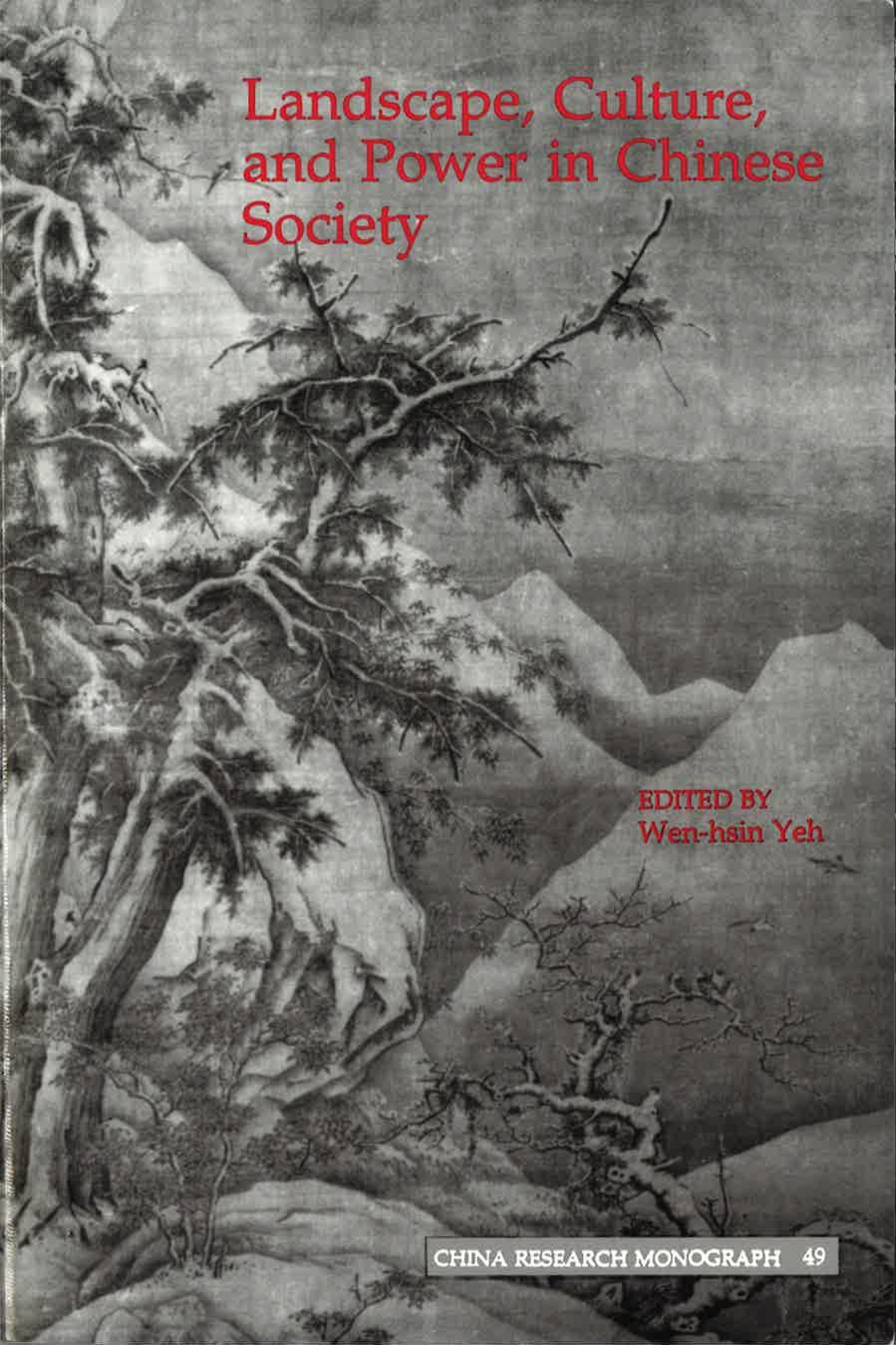
“The papers in the book were originally presented at the symposium on "Landscape, Culture, and Power in Chinese Society" held in 1996 at the University of California, Berkeley. The authors, from art, history, geography, and anthropology, are primarily concerned with two questions: "what does an attention to space, formal or informal, lived or represented, teach us about power relationships and the cultural dynamics that shaped Chinese society?" and "how did space function as a medium for the negotiation of power and politics in the particularities of Chinese society?" (ix). A central issue of the volume, as the editor Wen-hsin Yeh indicates, is the relation of neo-Confucianism, or Confucianism from the tenth to the twentieth century to the production of space (xiv-xv).” —Hai Ren, Bowling Green State University, Journal of Cultural Geography 20, no. 2 (2003): 103-104
"[I]n this book the interweaving of landscape, culture, and power are articulated over the centuries in the disciplines of Chinese art history, history, geography, and anthropology. Not only does each essay convince the reader of the immutable relationship among the three fundamental concepts that structure a nation's ideology, but the careful structure of the essays themselves convinces the reader that the manner in which the three concepts influence China is similar in all of these fields." —Nancy S. Steinhardt, University of Pennsylvania, China Review International 7, no. 1 (Spring 2000): 270–273
“[The authors] share the desire to break new ground or at least offer a new spatial angle to social relations in neo-Confucian culture. The result is a book which is a pleasure to read, and a starter for new research directions.” —Eduard B. Vermeer, Leiden University, Journal of the Economic and Social History of the Orient 43, no. 4 (2000): 591-592
“In the chapters of this book one senses a contemporary reorientation of China studies. The organizers of the symposium whence it grew are to be congratulated no less than the contributors of the notably original material.” —William Watson, in Journal of the Royal Asiatic Society, Third Series, Vol. 9, no. 3 (November 1999): 454-457
"The five essays in this collection set out to explore 'spatial ordering in Chinese culture and society from the Song to the present' (p. ix), with a particular focus on the relationship between spatial practices and the exercise of power. The authors, from a range of disciplinary standpoints, are all interested in ways in which interpretations of space may be contested, or at least deployed differentially, and it is thus a Foucauldian type of power as enabler of discourse rather than mere prohibition which is implicit in each of their pieces....In total then, this is an excellent and provocative collection: all the pieces are clearly written and cogently argued, and together they serve the important purpose of advancing the issue of space as part of the agenda for further research in the China field."—Craig Clunas, University of Sussex, The Journal of Asian Studies 58, no. 3 (August 1999): 823-824