University of California Press
Publishing Services

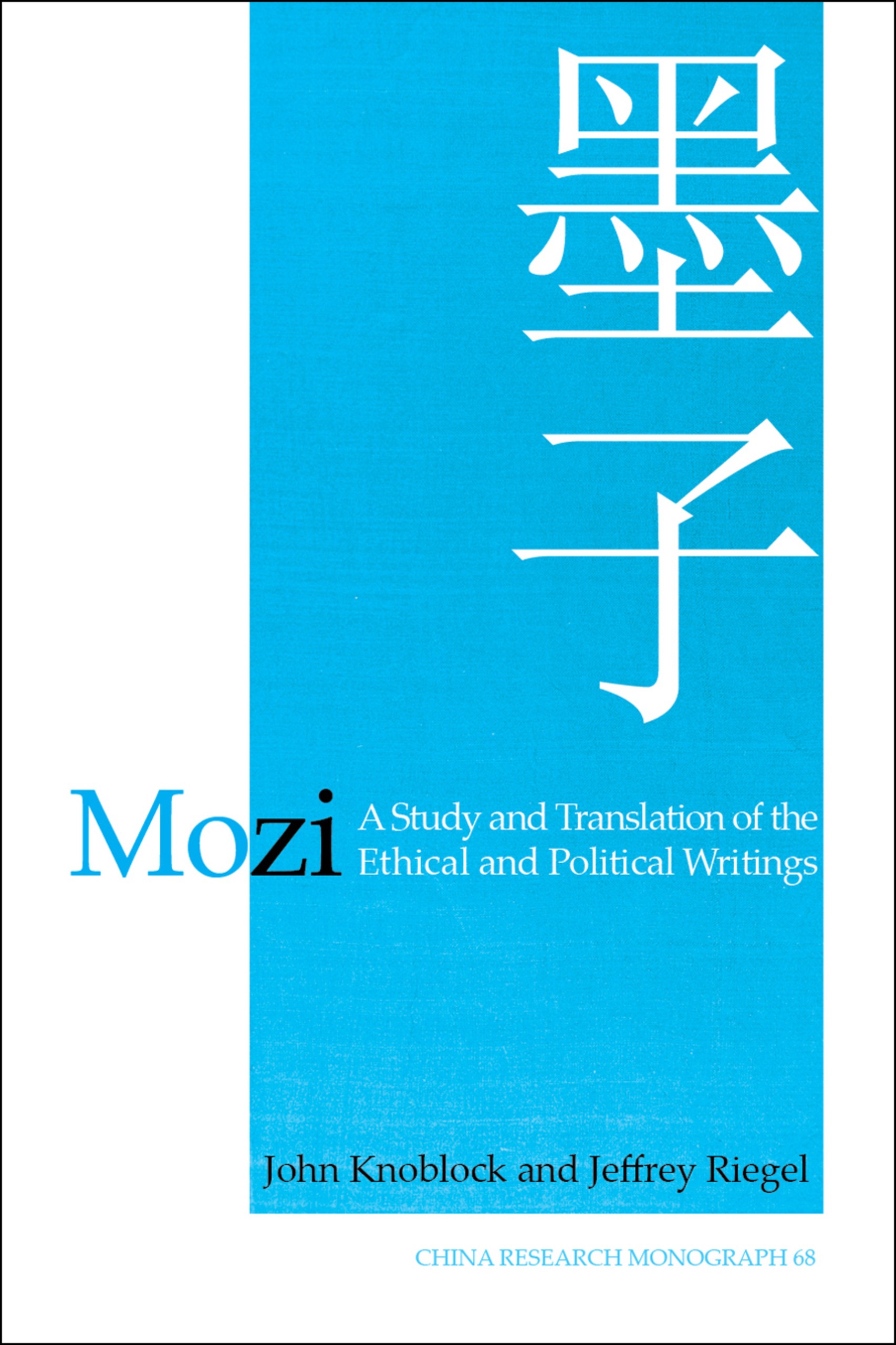
Mozi

A Study and Translation of the Ethical and Political Writings

by John Knoblock (Author), Jeffrey Riegel (Author)
Price: $45.00 / £38.00
Publication Date: Oct 2013
Publisher:
Institute of East Asian Studies, University of California, Berkeley
Imprint: Institute of East Asian Studies, University of California, Berkeley
Title Details:
Rights: World
Pages: 520
ISBN: 9781557291035
Trim Size: 6 x 9
Series:
  • China Research Monograph

About the Book

The authors of the Mozi an anthology of enormous scope and great importance can be credited with having produced during the Warring States period (453–221 BCE) the earliest extended philosophical discourse in China on a varied set of topics that range from aggressive warfare and prolonged mourning for the dead to frugality love for others and belief in divine agency. Professor Riegel's study and translation offers a new interpretation of the Mozi's thirty-six chapters on political and ethical philosophy. Based on an initial translation by the late John Knoblock Riegel's groundbreaking work attempts to understand the Mozi in light of excavated manuscripts and recent scholarship on ancient Chinese philosophy.

About the Author

John Knoblock was professor of philosophy at the University of Miami. He studied and translated several classical Chinese texts, including the Annals of Lü Buwei, Xunzi, and Mozi.

Jeffrey Riegel is professor emeritus of East Asian Languages and Cultures at the University of California, Berkeley. He is also professor emeritus of the School of Languages and Cultures at the University of Sydney. His research focuses on classical Chinese literature and early Chinese texts. He has studied and translated the Annals of Lü Buwei and Mozi. Education: M.A., Chinese, Stanford University; Ph.D., Chinese, Stanford University

Table of Contents

Tables 
Preface 
Abbreviations and Conventions 
Introduction 
    I. Portrayals of Mozi 
       1. Dates and Birthplace 
       2. Master Mo and Master Kong 
       3. Master Mo and the Xia Legacy 
       4. Mozi as a Baseborn Artisan 
       5. Mozi the Magician 

   II. The Mohist School 
       1. The Three Branches of Mohism 
       2. The First-Generation Disciples 
       3. The Grand Master 
       4. The "Law" of the Mohist Community 

   III. The Creation of the Text of the Mozi 

   IV. Mohism’s Fate 
       1. Dates and Birthplace 
       2. Mozi’s Daoist Persona 
       3. Knowledge of Mozi during the Tang and Song 
       4. The Ming and Qing Reassessment 
       5. Mozi in the Twentieth Century 

   V. The Philosophy of the Political and Ethical Chapters 
       1. The Chapters of Group 2 
       2. The Chapters of Group 1 
       3. The Chapters of Group 4 

Group 1: The Syncretic Writings
          Chapter 1: Cherishing Gentlemen 
        Chapter 2: Cultivate the Self 
        Chapter 3: On Dyes 
        Chapter 4: On the Proper Model 
        Chapter 5: Seven Worries 
        Chapter 6: Avoiding Excess 
        Chapter 7: Three Disputes 

Group 2: The Ten Doctrines
    Exalt the Worthy 
        Chapter 8: Exalt the Worthy (Upper) 
        Chapter 9: Exalt the Worthy (Middle) 
        Chapter 10: Exalt the Worthy (Lower) 
    Exalt Conformity 
        Chapter 11: Exalt Conformity (Upper) 
        Chapter 12: Exalt Conformity (Middle) 
        Chapter 13: Exalt Conformity (Lower) 
    Impartial Love 
        Chapter 14: Impartial Love (Upper)
        Chapter 15: Impartial Love (Middle) 
        Chapter 16: Impartial Love (Lower) 
    Condemn Aggression 
        Chapter 17: Condemn Aggression (Upper) 
        Chapter 18: Condemn Aggression (Middle) 
        Chapter 19: Condemn Aggression (Lower) 
    Moderate Consumption 
        Chapter 20: Moderate Consumption (Upper) 
        Chapter 21: Moderate Consumption (Middle) 
    Moderate Burials 
        Chapter 25: Moderate Burials (Lower) 
    Heaven’s Will 
        Chapter 26: Heaven’s Will (Upper) 
        Chapter 27: Heaven’s Will (Middle) 
        Chapter 28: Heaven’s Will (Lower) 
    Explaining Ghosts 
        Chapter 31: Explaining Ghosts (Lower) 
    Condemn Music 
        Chapter 32: Condemn Music (Upper) 
    Condemn Fatalism 
        Chapter 35: Condemn Fatalism (Upper) 
        Chapter 36: Condemn Fatalism (Middle) 
        Chapter 37: Condemn Fatalism (Lower)

Group 4: Condemn the Ru and the "Mohist Analects"
        Chapter 39: Condemn the Ru (Lower) 
        Chapter 46: Master Gengzhu 
        Chapter 47: Valuing Righteousness 
        Chapter 48: Master Gongmeng 
        Chapter 49: The Lord of Lu Asks a Question 
        Chapter 50: Master Gongshu 

Appendix A 
Appendix B 
Appendix C 
Additional Notes 
Bibliography 
Index
Reviews

"The translations are based on files and a critical edition left behind by the late John Knoblock, but they have been thoroughly reworked and edited by Riegel, who has authored most of the volume....Scholars of early China as well as non-specialist readers with an interest in Chinese philosophy will be grateful to Riegel for his persistence in bringing together Knoblock's original work on the Mozi and his own insights. The result is a fine piece of work that, while not necessarily revolutionizing existing scholarship on the Mozi, offers a richly annotated and solidly researched translation that will prove very useful as a first point of reference to this fascinating text."—Roel Sterckx, University of Cambridge, Bulletin of the School of Oriental and African Studies

“I find this study and translation initiated by John Knoblock and completed by Jeffrey Riegel truly impressive: it is a wonderful compendium of knowledge on Mozi and Mohism throughout Chinese history. It is often more informative than argumentative, sometimes reflecting on different views, offering well-balanced opinions, pointing at subtle variations, making connections with other sources (especially the Lüshi chunqiu), and providing reliable translations. In many ways this is the most useful (and affordable) Mozi book that has come out in the last decades.” —Carine Defoort, University of Leuven, China Review International 20, no. 3 & 4 (2013): 335–337.