University of California Press

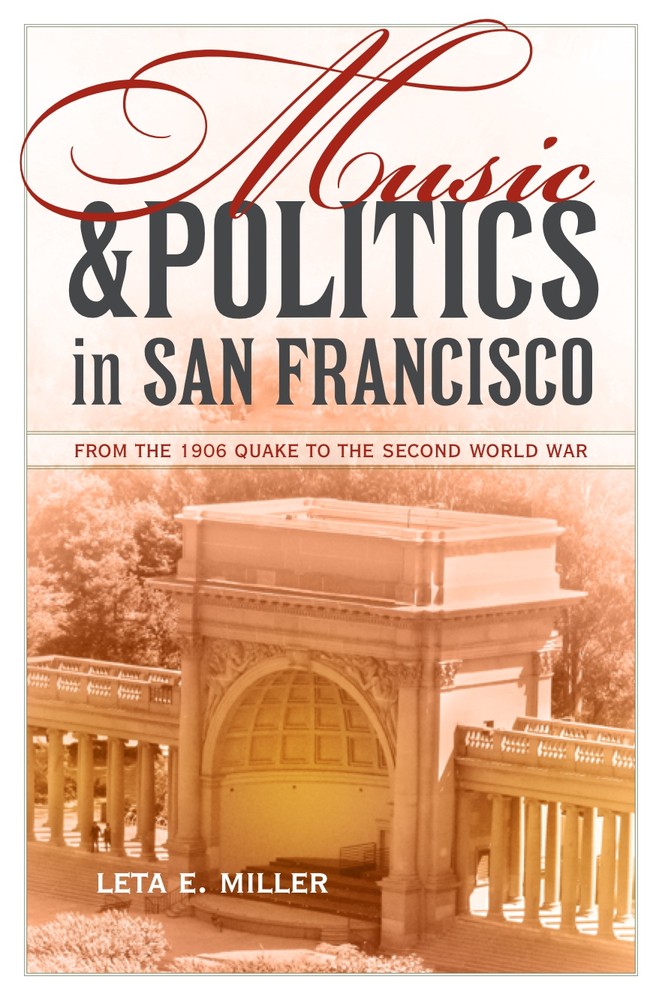
Music and Politics in San Francisco

From the 1906 Quake to the Second World War

by Leta E. Miller (Author)
Price: $65.00 / £55.00
Publication Date: Oct 2011
Edition: 1st Edition
Title Details:
Rights: World
Pages: 384
ISBN: 9780520268913
Trim Size: 6 x 9
Illustrations: 25 b/w photographs, 30 musical examples, 13 tables, 3 maps
Series:
Endowments:

About the Book

This lively history immerses the reader in San Francisco’s musical life during the first half of the twentieth century, showing how a fractious community overcame virulent partisanship to establish cultural monuments such as the San Francisco Symphony (1911) and Opera (1923). Leta E. Miller draws on primary source material and first-hand knowledge of the music to argue that a utopian vision counterbalanced partisan interests and inspired cultural endeavors, including the San Francisco Conservatory, two world fairs, and America’s first municipally owned opera house. Miller demonstrates that rampant racism, initially directed against Chinese laborers (and their music), reappeared during the 1930s in the guise of labor unrest as WPA music activities exploded in vicious battles between administrators and artists, and African American and white jazz musicians competed for jobs in nightclubs.

About the Author

Leta E. Miller is Professor of Music at the University of California, Santa Cruz and is coauthor (with Fredric Lieberman) of Composing a World: Lou Harrison, Musical Wayfarer and Lou Harrison.

Reviews

“Few histories or musicological studies provide as lively and entertaining reading as Music and Politics. Years of extensive research — through interviews, newspapers, archives — resulted in a mother lode of data, but the marvel of Miller's book is how she makes all that information coalesce in a colorful, memorable narrative.”
San Francisco Classical Voice
“A lively and compelling read.”
Forward
“[Miller] does not treat San Francisco as an insular subject, wisely referencing activities in the eastern US and Europe. . . . Solidly researched and of interest to a broad audience. . . . Highly recommended.”
Choice
“Solidly researched and of interest to a broad audience. . . . Highly recommended.”
Choice
"By inviting music into her study as circumscribed by time and place, rather than by style or genre, Miller presents a colorful tapestry of social relations mediated by the civic soundscape."
Journal of the Society for American Music
“Leta Miller’s long-awaited study is a tightly woven, fast-paced, and luminous chronicle of San Francisco’s musical coming of age. Her keen insights into Chinese opera, night club jazz, and two international expositions go far to rekindle the era’s spirited mix of talent, taste, patronage, and politics. The groundbreaking work of an accomplished music and social historian, Music and Politics in San Francisco is a most welcome companion to Catherine Parsons Smith’s Making Music in Los Angeles.

—Jonathan Elkus, Lecturer in Music Emeritus, UC Davis


“From three disastrous days in April 1906 through the onset of an even greater disaster in 1941, from the San Francisco Conservatory through the performances of the Chinese Opera, Leta Miller traces the musico-political history of ‘the Paris of the West’ in meticulous detail. This important book adds immeasurably to our knowledge of West Coast American music, whilst simultaneously challenging a number of historiographical shibboleths.”

—David Nicholls, contributing editor of The Cambridge History of American Music


"Leta Miller’s San Francisco’s Musical Life is a pure pleasure to read. Miller manages that rare feat of digesting what must have been many years of digging through newspapers and archives into a fun, lively, highly readable narrative. Each chapter strikes a comfortable balance among factual exposition, colorful anecdote, and historical analysis. Miller brings equal depth and insight to each of her disparate subjects, she writes with charm and clarity throughout, and the whole is arranged in a way that is clear and logical, never monotonous."

—Mary Ann Smart, author of Mimomania: Music and Gesture in Nineteenth-Century Opera