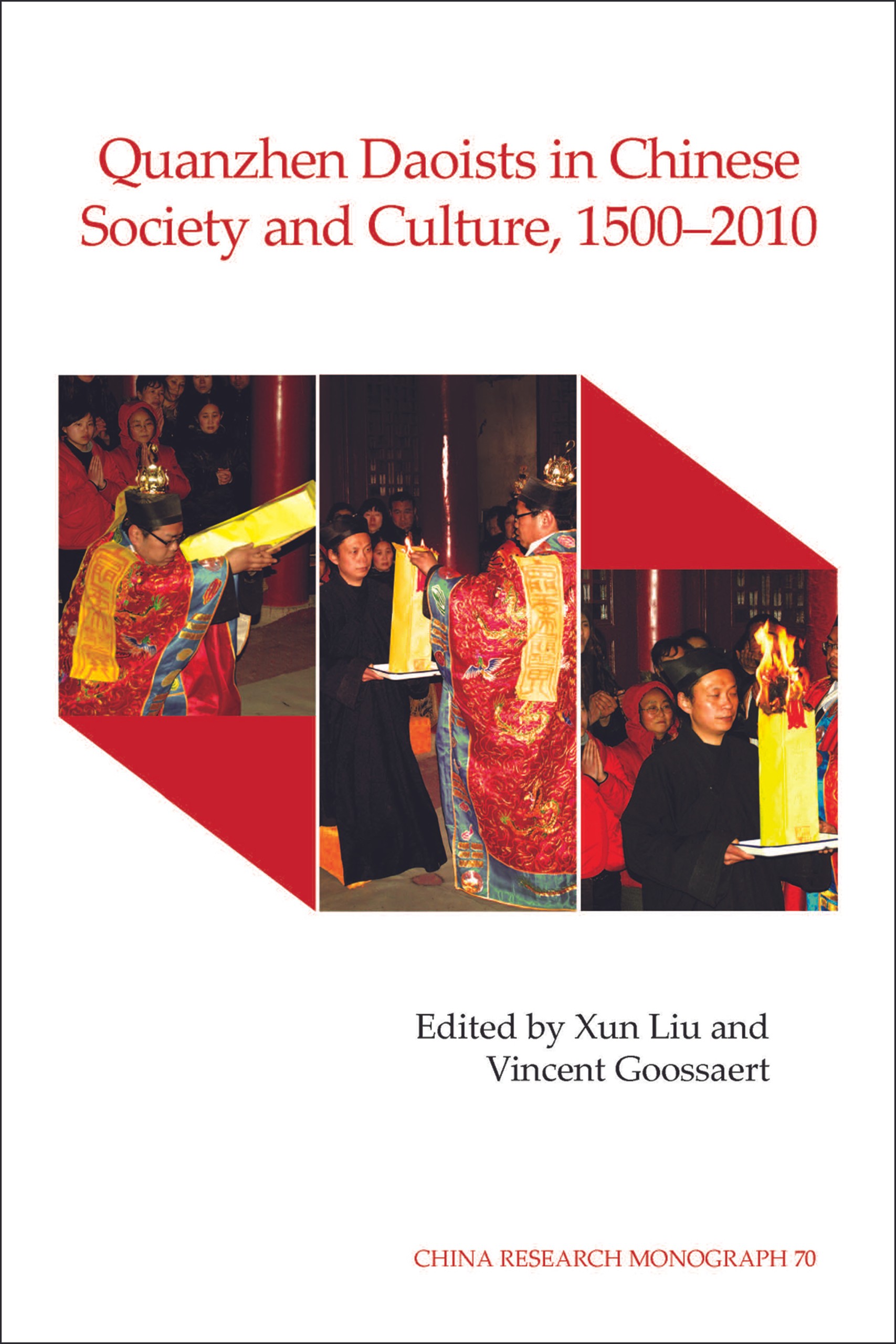
Quanzhen Daoists in Chinese Society and Culture, 1500–2010
- China Research Monograph
About the Author
Vincent Goossaert is professor of history at École Pratique des Hautes Études (EPHE) and serves as deputy director of Groupe Sociétés, Religions, Laïcités (GSRL). He works on the social history of modern religions in China. His coedited volumes include The Religious Question in Modern China (2011) and Quanzhen Daoists in Chinese Society and Culture, 1500-2010 (IEAS, 2013). Education: B.A., École des Hautes Études Commerciales (HEC); M.A., Université Paris 4 DEA, Sciences Religieuses, École Pratique des Hautes Études (EPHE), Paris; Ph.D., Sciences Religieuses, EPHE, Paris
Table of Contents
Contributors – ix
Acknowledgments – xi
Conventions – xiii
Introduction – 1
Xun Liu and Vincent Goossaert
Part 1. Making Quanzhen Identities
1. Quanzhen, What Quanzhen? Late Imperial Daoist Clerical Identities in Lay Perspective – 19
Vincent Goossaert
2. The Invention of a Quanzhen Canon: The Wondrous Fate of the Daozang jiyao – 44
Monica Esposito
3. A Late Qing Blossoming of the Seven Lotus: Hagiographic Novels about the Qizhen – 78
Vincent Durand-Dastès
4. Globalizing Daoism at Huashan: Quanzhen Monks, Danwei Politics, and International Dream Trippers – 113
David A. Palmer
Part 2. Quanzhen Textual and Ritual Productions
5. Quanzhen and Longmen Identities in the Works of Wu Shouyang – 141
Paul G. G. Van Enckevort
6. Being Local through Ritual: Quanzhen Appropriation of Zhengyi Liturgy in the Chongkan Daozang jiyao – 171
Mori Yuria
7. Quanzhen Daoism and Ritual Medicine: A Study of ""Thirteen Sections of Zhuyou Medicine from the Yellow Emperor Inscription"" – 208
Fang Ling
Part 3. Quanzhen Daoists and Local Society
8. A Local Longmen Lineage in Late Ming–Early Qing Yunnan – 235
Richard G. Wang
9. Quanzhen Proliferates Learning: The Xuanmiao Temple, Clerical Activism, and the Modern Reforms in Nanyang, 1880s–1940s – 269
Xun Liu
10.Temple and Household Daoists: Notes from North China – 308
Stephen Jones
Bibliography – 335
Index – 369
Reviews
“This detailed work is aimed at specialists in the field but also at a wider intellectual audience interested in Chinese society as a whole and the complex religious landscape that in part defines it. It will doubtless become a precious manual for university students of religious studies and Chinese history….One major appeal of the work is that, through variations in approach, scale and perspective (historical, Sinological, sociological, and anthropological), it succeeds in demonstrating that Quanzhen has not been a homogeneous category in time or space.” —Adeline Herrou, Centre National de la Recherche Scientifique, Laboratoire d’Ethnologie et de Sociologie Comparative (France), Daoism: Religion, History and Society, no. 8 (2016): 294–309