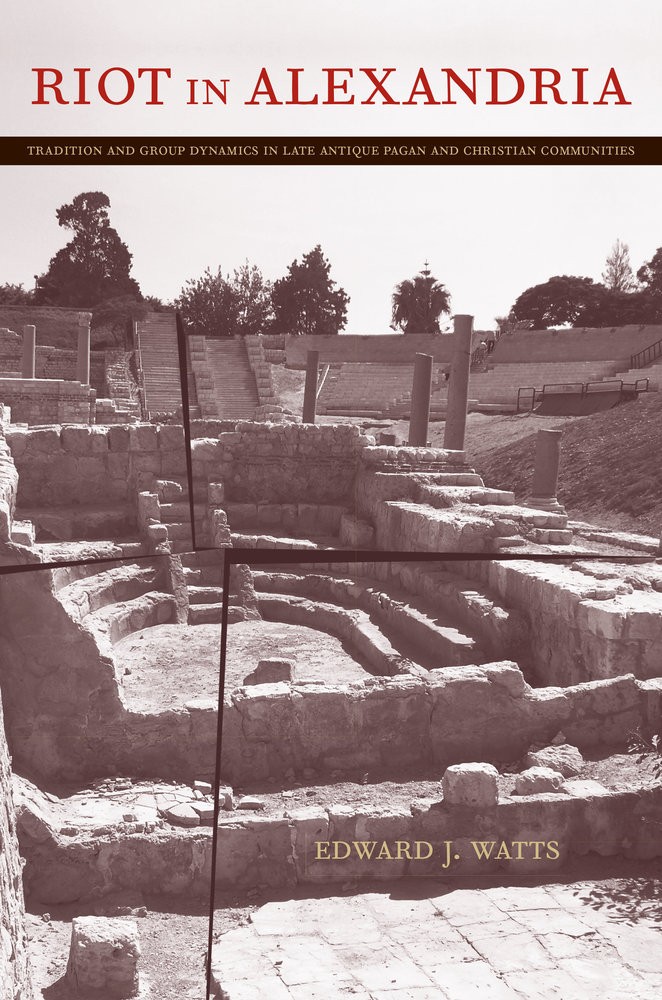
About the Book
This innovative study uses one well-documented moment of violence as a starting point for a wide-ranging examination of the ideas and interactions of pagan philosophers, Christian ascetics, and bishops from the fourth to the early seventh century. Edward J. Watts reconstructs a riot that erupted in Alexandria in 486 when a group of students attacked a Christian adolescent who had publicly insulted the students' teachers. Pagan students, Christians affiliated with a local monastery, and the Alexandrian ecclesiastical leaders all cast the incident in a different light, and each group tried with that interpretation to influence subsequent events. Watts, drawing on Greek, Latin, Coptic, and Syriac sources, shows how historical traditions and notions of a shared past shaped the interactions and behavior of these high-profile communities. Connecting oral and written texts to the personal relationships that gave them meaning and to the actions that gave them form, Riot in Alexandria draws new attention to the understudied social and cultural history of the later fifth-century Roman world and at the same time opens a new window on late antique intellectual life.
Table of Contents
List of Illustrations
Acknowledgments
1. The Anatomy of a Riot
Part 1. Historical Discourse in Intellectual Communities
2. Personal Legacy and Scholastic Identity
Internal Historical Discourse and Its Transmission: The Example of Eunapius
Defending Communal Historical Discourse: Porphyry’s Life of Plotinus
3. Past, Present, and Future in Late Neoplatonic Historical Discourse
The Life of Isidore and its Sources
Eating, Drinking, and Learning Neoplatonic History
Oral Tradition and Scholastic Identity in the Alexandrian Schools of the 480s
Paralius’s Beating within its Scholastic Context
Fifth-Century Christian Violence in Neoplatonic Communal Memory
Teaching Ethics after the Riot
Part 2. The Past Within and Outside Late Antique Monasteries
4. History and the Shape of Monastic Communities
The Koinonia
The Historia Monachorum and Visitors’ Exposure to Ascetic Oral Traditions
Social Relations and the Power of the Master: Barsanuphius and John
5. Anti-Chalcedonian Ascetics and their Student Associates
The Limits of Ascetic Influence
Finding the Ascetic and Intellectual Balance
The Ascetic and Sophistic Mélange of Zacharias Scholasticus
A Student Riot and its Commemoration: The “Life of Paralius”
Part 3. Defining the Alexandrian Bishop
6. Creating the Legend of the Alexandrian Bishop
Mechanisms of Episcopal Power
Athanasius and the Politics of Self-Definition
Athanasius’s Restoration and Redefinition
The Athanasian Historical Legacy
7. Theophilus and Cyril: The Alexandrian Bishop Triumphant
Theophilus and the Historical Character of Athanasius
The Legacy of Theophilus
8. Peter Mongus Struggles with the Past
Chalcedon and the Redefinition of the Alexandrian Bishop
Peter Mongus and Resistance in an Age of Compromise
Peter Mongus and the Beating of Paralius
A Riot’s Aftermath
9. Conclusion
Appendix 1. Dating the Riot
Appendix 2. How Much Should We Trust Zacharias Scholasticus?
Bibliography
Index