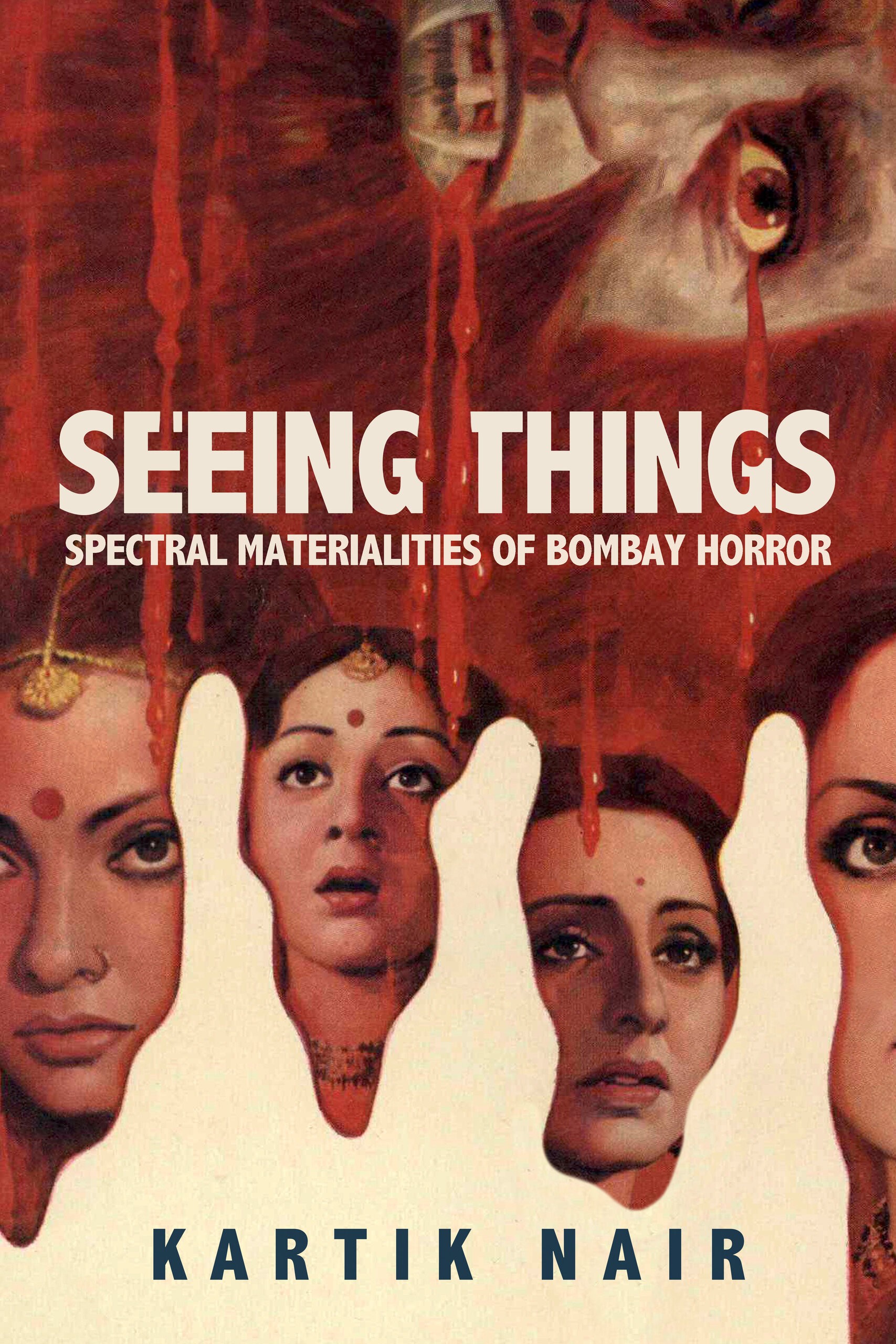
"Nair’s Seeing Things marks a milestone in contemporary scholarly attention to the history of Indian cinemas."
— South Asian Review
“An embarrassment of riches, where index rubs against index, forming palimpsests ready to be activated and dissected. . . . Seeing Things reveals a broad historical scope that encompasses independent film production, circulation, and regulation at a critical turning point in India’s film history.”
"Nair weaves a unique tale of the materiality of Bombay horror. . . [The] book pulsates with thrilling descriptions of shooting, screening, censoring, losing, finding and restoring the Bombay horror genre, all the while highlighting and celebrating its distortions and failures."
"By encouraging us to rethink horror and Indian cinemas in ways that affect the study of other kinds of films as well, Seeing Things is poised to make significant conceptual, historical, and methodological contributions to the field."
"This thrilling book does something rare and indispensable: it influentially teaches us how to read film. Innovating a method of analysis to match the unforgettable horror films of 1980s Bombay, Kartik Nair is an expert materialist and obsessed cinephile in Seeing Things, pursuing failed prosthetics, frayed frames, and hallucinogenic mists to expose the crafts, technologies, and lives inscribed in the cinematic macabre. Riveting, revelatory, and with inimitable style, Seeing Things will reshape the scholarly canon in popular horror, film historiography, Indian cinema, film art, and new materialism."—Priya Jaikumar, author of Where Histories Reside: India as Filmed Space
"A wholly original and expansive thinker, Nair energizes horror scholarship, production studies, and film theory with fresh questions drawn from archival research and below-the-line interviews on low-budget Bombay cinema, in contrast to polished Bollywood fare. His bravura analysis of Bombay horror is attuned to overlooked material traces of censorship, craft, and circulation, while also probing production errors and special effects for their historiographic richness. At heart an argument for a potent new methodology, Seeing Things teaches us to be attuned to telling details and eloquent failures. For breathing new life into film studies, this is a must-read book."—Bliss Cua Lim, author of Translating Time: Cinema, the Fantastic, and Temporal Critique
"Seeing Things demonstrates how visual traces of a film's production, regulation, and circulation can illuminate below-the-line industrial histories and shape spectatorial experience. Blending textual analysis with archival research, original interviews with phenomenological experience, and rigor with wit, Nair pioneers an exciting new approach to materialist media studies."—Caetlin Benson-Allott, author of The Stuff of Spectatorship: Material Cultures of Film and Television
"Engrossing! Nair lavishes attention on films that will be unknown to many readers, and lends bracing specificity to things that receive only glancing attention in other studies: props, masks, and censor certificates. With a contagious fondness for glitches, marginalia, artifacts, minutiae, and ephemera—for the materiality of Bombay's horror films—Seeing Things pleasurably plunges readers into a riot of small details as a way to bring a geographically and historically local set of filmmaking practices to life. This meticulously researched, vividly written book is a must-read for scholars of cinematic horror."—Robert Spadoni, author of Uncanny Bodies: The Coming of Sound Film and the Origins of the Horror Genre
"With remarkable originality, Seeing Things subjects horror films to a materialist attention to paper, latex, celluloid, and videotape—and to the powers, labors, and accidents that shape the genre's excesses. Nair has turned the customary grounds of subcultural fascination with 'so bad they're good' films into a reflexive reading strategy that bridges the distance between the state and the spectator, the movie and the medium, in endlessly surprising ways. This eloquent history of a genre is also a striking reflection on the historiography of Indian cinema, giving Bombay's horror films one last laugh at the forces that rendered them imperiled at every turn."—Sudhir Mahadevan, author of A Very Old Machine: The Many Origins of the Cinema in India