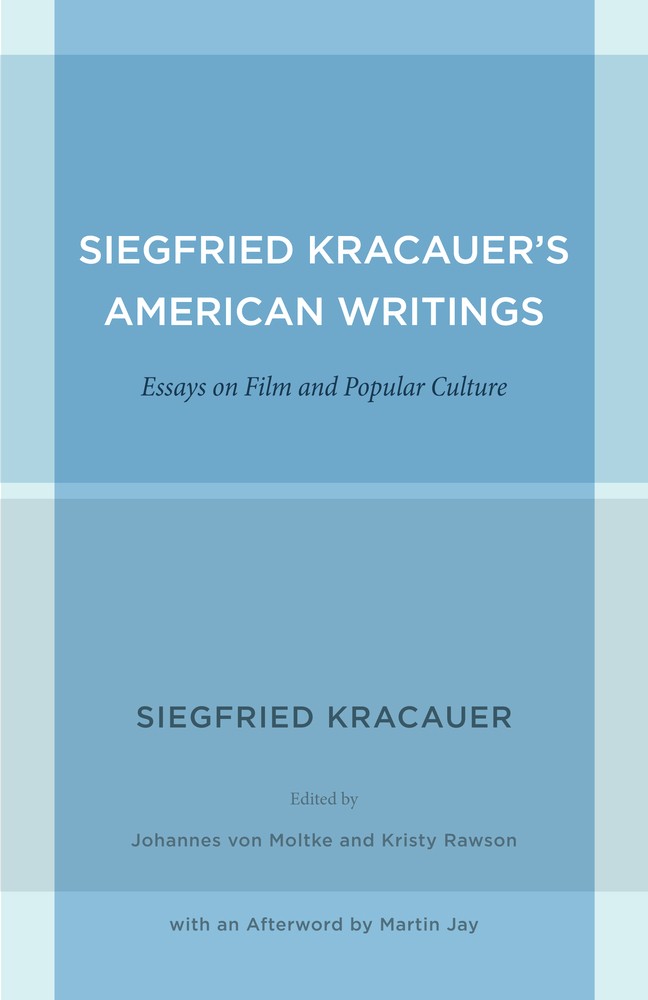
About the Book
Siegfried Kracauer (1889–1966), friend and colleague of Walter Benjamin and Theodor Adorno, was one of the most influential film critics of the mid-twentieth century. In this book, Johannes von Moltke and Kristy Rawson have, for the first time assembled essays in cultural criticism, film, literature, and media theory that Kracauer wrote during the quarter century he spent in America after fleeing Nazi-occupied Europe. In the decades following his arrival in the United States, Kracauer commented on developments in American and European cinema, wrote on film noir and neorealism, examined unsettling political trends in mainstream cinema, and reviewed the contemporary experiments of avant-garde filmmakers. As a cultural critic, he also ranged far beyond cinema, intervening in debates regarding Jewish culture, unraveling national and racial stereotypes, and reflecting on the state of arts and humanities in the 1950s. These essays, together with the editors' introductions and an afterward by Martin Jay offer illuminating insights into the films and culture of the postwar years and provide a unique perspective on this eminent émigré intellectual.
Table of Contents
Preface: Notes on the Edition
Acknowledgments
Introduction: Affinities
Part I. A Cultural Critic in New York
1. Why France Liked Our Films (1942)
2. Hollywood’s Terror Films (1946)
3. Jean Vigo (1947)
4. The Revolt against Rationality (1947)
5. On Jewish Culture (1947)
6. Filming the Subconscious (1948)
7. Psychiatry for Everything and Everybody (1948)
8. Those Movies with a Message (1948)
9. National Types as Hollywood Presents Them (1949)
10. The Mirror Up to Nature (1949)
11. Preston Sturges, or Laughter Betrayed (1950)
12. Art Today (1961)
13. About the State of the Humanities
14. A Statement on the Humanistic Approach
15. Talk with Teddie (1960)
Part II. Film Reviews
16. An American Experiment (1941)
17. Dumbo (1941)
18. Film Notes from Hollywood (1941)
19. A Few American Films (1941)
20. William Wyler’s New Bette Davis Film (1941)
21. Flaherty, The Land (1942)
22. For Whom the Bell Tolls (1943)
23. Paisan (1948)
24. The Decent German (1949)
25. The Eternal Jew (1956)
26. A Few Notes on The Connection (1961)
Part III. Book Reviews
27. In Eisenstein’s Workshop (1943)
28. The Russian Director (1949)
29. The Movie Colony (1942)
30. A Lady of Valor (1947)
31. The Teutonic Mind (1948)
32. Consciousness, Free and Spontaneous (1948)
33. Indologian Holiday (1948)
34. Portrait in Film (1948)
35. Total Teaching (1949)
36. Pictorial Deluge (1950)
37. Movie Mirror (1950)
38. Réflexion faite (1952)
Part IV. Toward a Theory of Film
39. Stage vs. Screen Acting (1950)
40. The Photographic Approach (1951)
41. Silent Film Comedy (1951)
42. The Found Story and the Episode (1956)
43. Letter to film 56 (1956)
Afterword: Kracauer, the Magical Nominalist / Martin Jay
Notes
Index