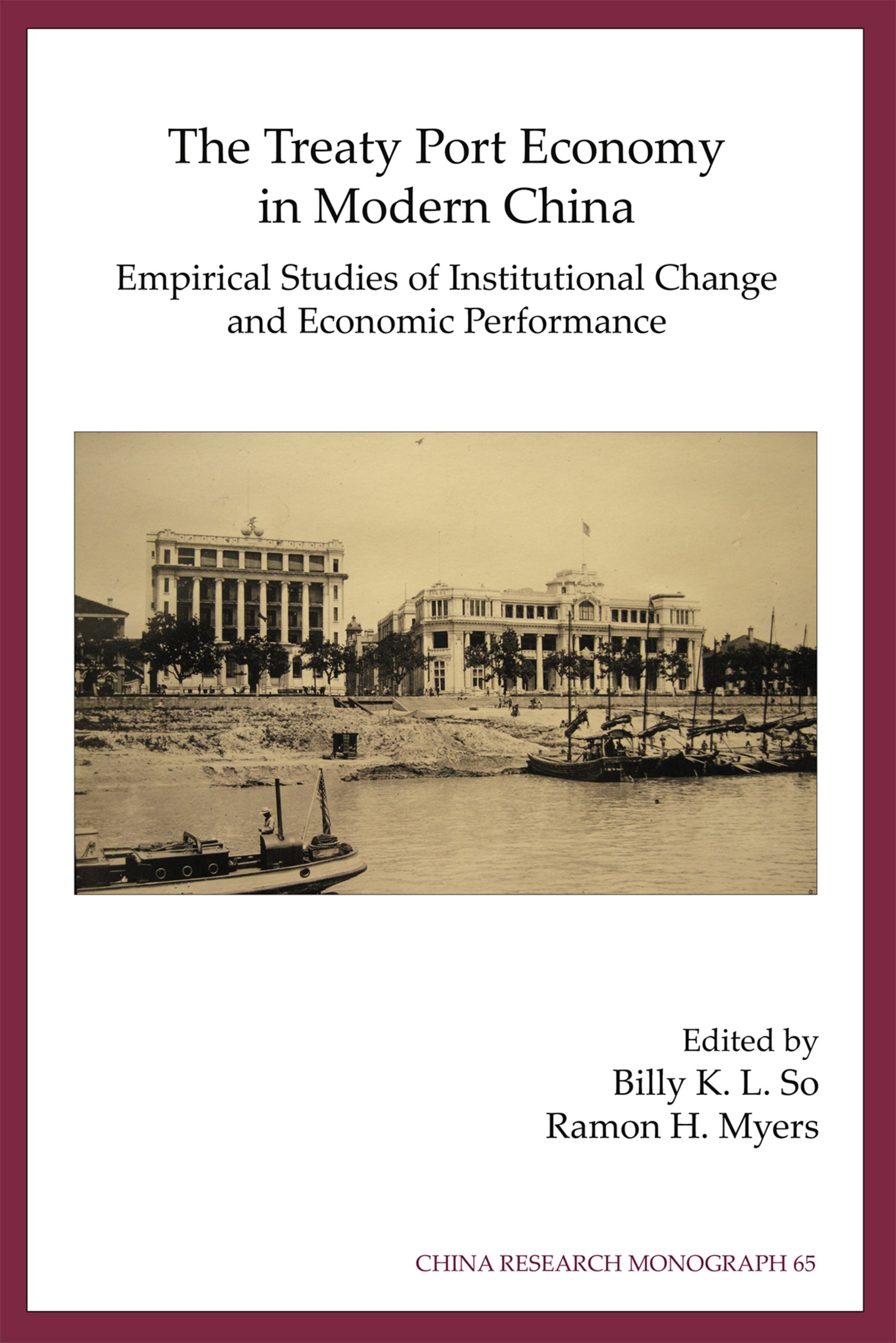
The Treaty Port Economy in Modern China
- China Research Monograph
About the Author
Education: B.A., The Chinese University of Hong Kong; M.A., The Chinese University of Hong Kong; Ph.D., Australian National University
Ramon H. Myers was a senior fellow at the Hoover Institution, Stanford University. His scholarship and public policy interests included Chinese economic history, Japanese imperialism, Taiwanese history, and Asian international relations. He is the author of The Chinese Peasant Economy (Harvard University Press, 1970), The Chinese Economy, Past and Present (Wadsworth Press, 1978), and co-editor of The Treaty Port Economy in Modern China (Institute of East Asian Studies, 2011). He passed away in fall 2015.
Education: Ph.D., Economics, University of Washington
Table of Contents
Acknowledgements
Contributors
1. Modern China's Treaty Port Economy in Institutional Perspective: An Introductory Essay
Billy K.L. So
PART ONE: Institutional Change and Economic Growth
2. The rise of Modern Shanghai: 1900-1936: An Institutional Perspective
Debin Ma
3. The Shanghai Real Estate Market and Capital Investment, 1860-1936
Tomoko Shiroyama
4. The Rice and Wheat Flour Market Economies in the Lower Yangzi, 1900-1936
Kai-yiu Chan
5. The Regional Development of Wei County's Cotton Textile Market Economy. 1920-1937
Hon-ming Yip
6. Chinese Farmer Rationality and the Agrarian Economy of the Lower Yangzi in the 1930s
James Kai-sing Kung, Daniel Yiu-fai Lee, and Nansheng Bai
PART TWO: Dynamics in Institutional Change
7. Traditional Land Rights in Hong Kong's New Territories
Kentaro Matsubara
8. Chinese Enteprises across Cultures: The Hong Kong Business Experience in the Early Twentieth Century
Stephanie Po-yin Chung
9. Legalization of Chinese Corporation, 1904-1929; Innovation and Continuity in Rules and Legislation
Billy K.L. So and Albert S. Lee
Bibliography
Index
Reviews
"These studies of institutional changes in China's treaty port economies introduce the challenges and potential payoffs of understanding how institutions affect economic performance. With rich and diverse empirircal material, they provide perspective on more recent Chinese economic reforms and the ways in which economic growth need neither intend nor result in prosperity for all."—R. Bin Wong, University of California, Los Angeles
"The edited volume under review here is one of the most important to have been published on China's pre-war economy in recent years. Readers wary of this genre will be pleasantly surprised, since this compilation of studies penned by different scholars is a far cry from the all-too-common re-hashed conference proceedings. Rather, as the title suggests, the volume integrates much newly mined empirical evidence with intelligent analyses, and features numerous mutually-complementary insights into hitherto neglected aspects of the Treaty Port microcosm." —Niv Horesh, University of Western Sydney and University of Nottingham, International Journal of Asian Studies
