University of California Press

About the Book

David G. García is Assistant Professor in the Graduate School of Education and Information Studies at the University of California, Los Angeles.

About the Author

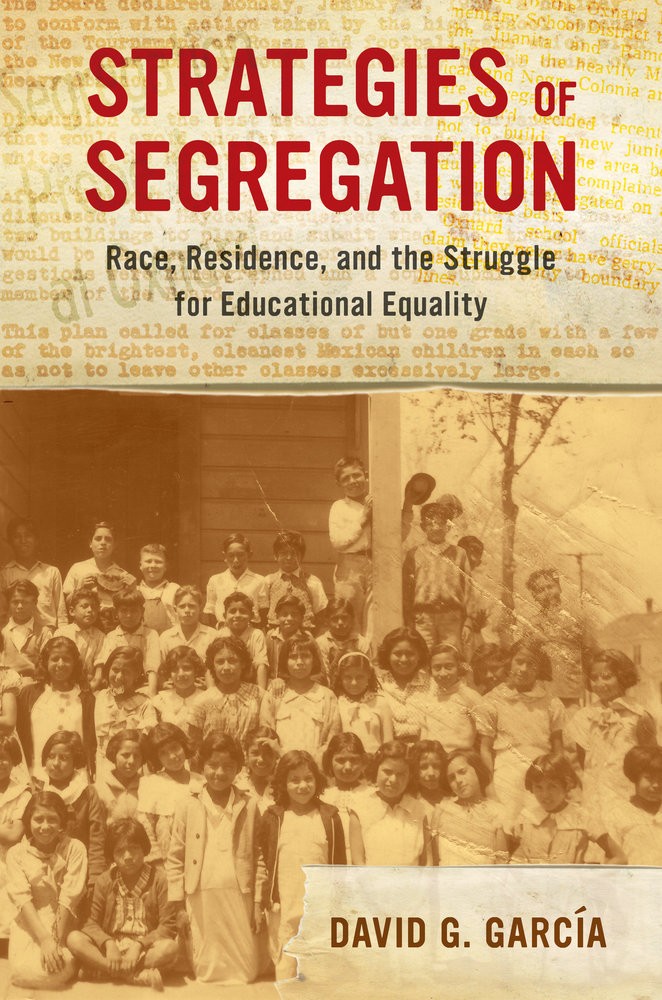
and the Struggle for Educational Equality

From Our Blog

Announcing our Recent Award-winning Authors

UC Press is proud to publish award-winning authors and books across many disciplines. These scholars have been acknowledged for their exemplary scholarship, theoretical innovations, contributions to advancing social justice, and so much more. We're honored to be their publisher.Learn more about
Read More

Table of Contents

Strategies of Segregation is a carefully researched, effectively argued, and beautifully written study of the centrality of school segregation to the racialization of space and the spatialization of race in Oxnard, California. Its deft blend of evidence from archival and oral history sources makes a major contribution to the histories of school and residential segregation. This fine book also reveals how Mexican Americans and Blacks fought back and battled for educational equity and racial justice.”—George Lipsitz, author of The Possessive Investment in Whiteness
 
“Through a study of how school segregation and residential segregation reinforce one another, Strategies of Segregation examines how structural racism became embedded in Oxnard, a city just north of Los Angeles. David G. García’s analysis across multiple urban institutions and interlocking racial practices will make this a model book for years to come.”—Natalia Molina, author of How Race Is Made in America: Immigration, Citizenship, and the Historical Power of Racial Scripts
 
“García offers an original interpretation of school segregation and racial subordination with a rich and well-documented foundation of primary sources that vividly recreate schemes to subordinate Mexicans and African Americans in Oxnard. This outstanding book speaks to national issues of segregation, racial inequality, and resistance and will command the attention of the larger academy.”—James D. Anderson, author of The Education of Blacks in the South, 1860–1935  
 
Strategies of Segregation is a provocative and engaging book that will broaden our understanding of the history of Mexican American education. This book is a must-read for historians and education policymakers.”—Rubén Donato, author of Mexicans and Hispanos in Colorado Schools and Communities, 1920–1960

Strategies of Segregation is a welcome addition to emerging studies on race, place, and schooling in the American West. García effectively disrupts the traditional divide between de facto and de jure segregation and complicates conventional understandings of community activism among Mexican Americans and African Americans.”—Joy Ann Williamson-Lott, author of Radicalizing the Ebony Tower: Black Colleges and the Black Freedom Struggle in Mississippi


Reviews

"Wherever this historiography [of education] moves next, scholars will do well to engage with the work of García."
History of Education
"Delves into political tensions within Oxnard, California, and illustrates the board of education’s decisions enacting segregation and thereby shaping the education of Mexicans and blacks . . . The work uncovers hidden histories of Mexican American and black struggles to end segregation, and it results in a very rich study."
American Historical Review
"Provides a meticulous, nuanced, and brilliant study of the complex layers behind the historical connections of educational and residential segregation."
Latino Studies

"Amid the racial reckoning and protests that have swept this country, Strategies of Segregation is a timely and invaluable contribution to California history, Chicano/a studies, and ethnic studies."


California History
Strategies of Segregation is a carefully researched, effectively argued, and beautifully written study of the centrality of school segregation to the racialization of space and the spatialization of race in Oxnard, California. Its deft blend of evidence from archival and oral history sources makes a major contribution to the histories of school and residential segregation. This fine book also reveals how Mexican Americans and Blacks fought back and battled for educational equity and racial justice.”—George Lipsitz, author of The Possessive Investment in Whiteness
 
“Through a study of how school segregation and residential segregation reinforce one another, Strategies of Segregation examines how structural racism became embedded in Oxnard, a city just north of Los Angeles. David G. García’s analysis across multiple urban institutions and interlocking racial practices will make this a model book for years to come.”—Natalia Molina, author of How Race Is Made in America: Immigration, Citizenship, and the Historical Power of Racial Scripts
 
“García offers an original interpretation of school segregation and racial subordination with a rich and well-documented foundation of primary sources that vividly recreate schemes to subordinate Mexicans and African Americans in Oxnard. This outstanding book speaks to national issues of segregation, racial inequality, and resistance and will command the attention of the larger academy.”—James D. Anderson, author of The Education of Blacks in the South, 1860–1935  
 
Strategies of Segregation is a provocative and engaging book that will broaden our understanding of the history of Mexican American education. This book is a must-read for historians and education policymakers.”—Rubén Donato, author of Mexicans and Hispanos in Colorado Schools and Communities, 1920–1960

Strategies of Segregation is a welcome addition to emerging studies on race, place, and schooling in the American West. García effectively disrupts the traditional divide between de facto and de jure segregation and complicates conventional understandings of community activism among Mexican Americans and African Americans.”—Joy Ann Williamson-Lott, author of Radicalizing the Ebony Tower: Black Colleges and the Black Freedom Struggle in Mississippi


Awards

  • The New Scholar’s Book Award Honorable Mention 2019, American Educational Research Association
  • Critics' Choice Book Award 2019, American Educational Studies Association
  • Outstanding Book Award 2020, Society of Professors of Education