University of California Press

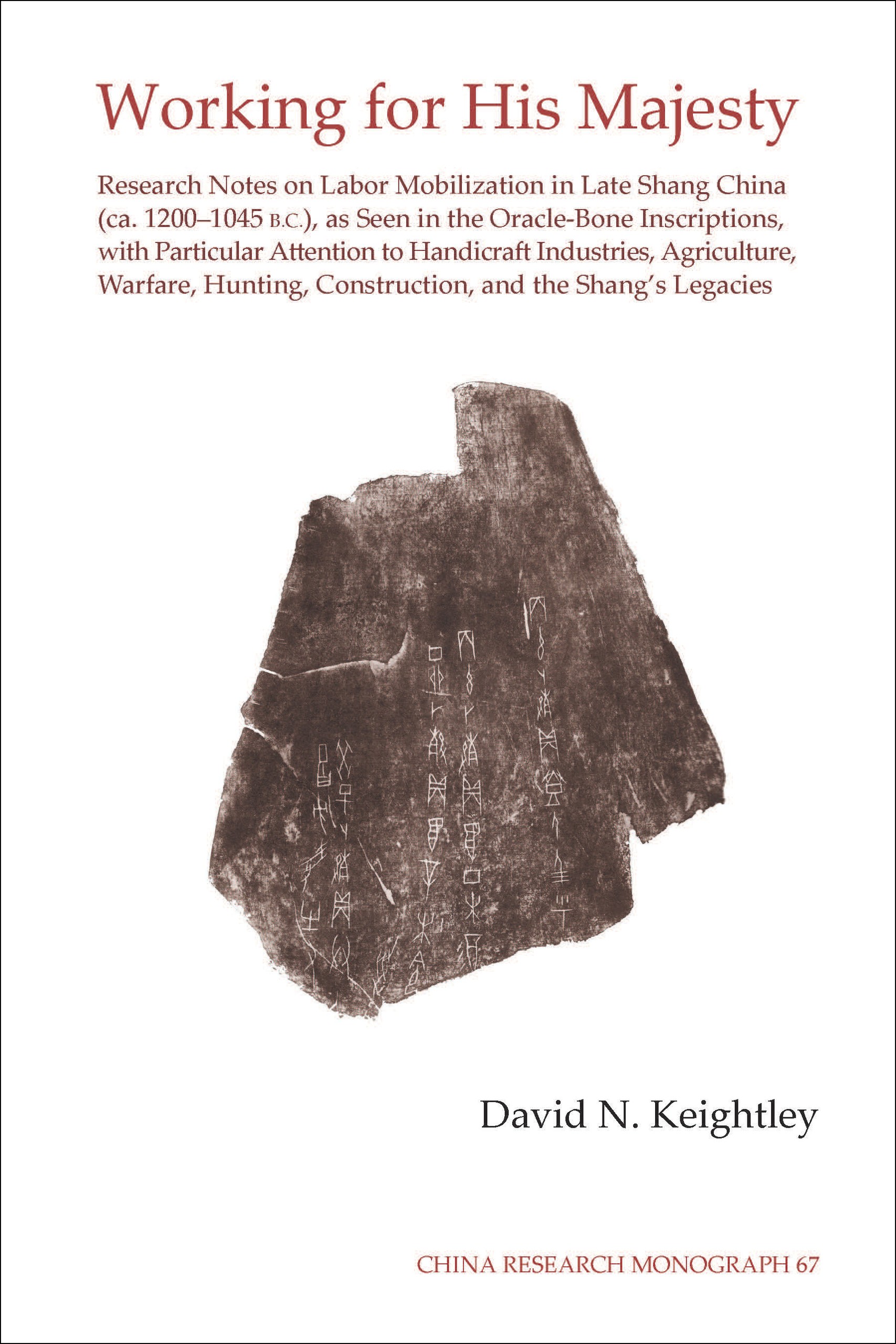
Working for His Majesty

Research Notes on Labor Mobilization in Late Shang China (ca. 12001045 B.C.), as Seen in the Oracle-Bone Inscriptions, with Particular Attention to Handicraft Industries, Agriculture, Warfare, Hunting, Construction, and the Shang's Legacies

by David N. Keightley (Author)
Price: $45.00 / £38.00
Publication Date: Aug 2012
Publisher: Institute of East Asian Studies, University of California, Berkeley
Imprint: Institute of East Asian Studies, University of California, Berkeley
Title Details:
Rights: World
Pages: 532
ISBN: 9781557291028
Trim Size: 6 x 9
Series:
  • China Research Monograph

About the Book

This volume deals with the Shang ? dynasty (ca. 12001045 B.C.) in North China, the first to leave written records, and its effortsevidently with great successwhich focused on the artisan corps, labor mobilization, farming, warfare, hunting, building, leadership, and culture that made it all possible. Keightley looks at oracle-bone inscriptions of the Late Shang dynasty, covering the period from Wu Ding ?? (ca. ?1189 B.C.) to Di Xin ?? (ca. 10861045 B.C.). His account of Late Shang labor mobilization is based primarily upon information that can be gleaned from the oracle-bone inscriptions, whose dynastic biases and divinatory impulses must be taken into account. The complexity and belief systems of the rest of Shang life must never be ignored. The author had translated 102 Shang oracle bones in his dissertation; the present work has 341 of them, often with several charges on the bone or shell. The volume includes a glossary of Shang terms and phrases.

About the Author

David Keightley was professor emeritus of history at the University of California, Berkeley. His research has focused on early Chinese civilization and oracle bone script. His publications include Sources of Shang History: The Oracle-Bone Inscriptions of Bronze Age China, The Ancestral Landscape: Time, Space, and Community in Late Shang China (ca. 1200-1045 B.C.), and Working for His Majesty. Education: B.A., Columbia University; Ph.D., Columbia University

Table of Contents

Preface xi
Notes about the Sources, Citation, and Transcription Conventions xvii

1. Introduction: The Setting 1
2. The Work and the Workshops 9
       Bone Working: 9
       Stone and Jade Working: 13
       Pottery: 15
       Textiles: 16
       Wood Working: 17
       Bronze Casting: 19
       Cowries: Bone and Bronze: 26
       The Emergence of Writing: 27
       The Workshops: 28
       The Products: 30
3. The Artisan Corps 33
       The Status of the Artisans: 33
       The Duo Gong ??: 34
       ""The Many Strikers"": 40
       Summary: 44
       The Dependent Laborers of Shang: 46
       A Note on Population: 48
4. The Zhong ? and the Ren ? 50
       The Status of the Workers: Slave, Free, or Dependent: 53
       The Differences Between the Zhong  ? and the Ren ?: 58
5. Punishments, Human Sacrifice, and Accompanying-in-Death 63
       Possible Punishments: 63
       The Qiang ? and Duo Qiang ??: A Sample Case: 66
       Human Sacrifice and Accompanying-in-Death: 69
6. Labor Mobilization 78
       The Verbs for ""Mobilize"": 78
       The Verbs for ""Making an Offering"": 81
7. Who Was Mobilized 86
8. The Occupational Lineages 92
9. Numbers 97
       Accuracy of the Figures: 99
       Casualties among the Zhong ?: 101
       Casualties among the Ren ?: 104
10. Work Schedule of the Diviners 106
       Discussion: 116
11. Leadership 119
12. The Work: Agriculture 124
       The Agricultural Context: 125
       Late Shang Agriculture: 126
              The Powers and the Weather: 129
              Agricultural Tools: 131
       The Yi ? and Tian ?: 132
       The Peasantry and the Population: 135
       Dynastic Agriculture: 136
       The Ritual Dimension: 152
       Opening Up New Land: 161
       The Use of Fire: 166
       Irrigation: 168
       Conclusions: 173
13. The Work: Warfare 174
       Leadership in Warfare: 174
       Army Organization: 179
       Penetration: 184
       Horse-chariot Units and the Shang Army: 187
       Shang Weapons: 189
       Shang Military History: 190
14. The Work: Hunting 194
15. The Work: Construction 200
       Wall Construction: 200
       Rammed-Earth Construction: 203
       Settlements and Buildings: 204
       Temples and Other Buildings: 205
       Drainage: 208
       Royal and Other Tombs: 210
16. Some Elements of Ritual Concern 214
17. The Role of Geopolitics and Culture 220
       Ancestor Worship: 220
       Other Demands for Work: 226
       The Role of Writing: 230
       The Creation of the Ancestors: 232
18. The Legacies 236

Figure 224
Tables 246
Appendix 1: Inscription Glosses 250
Appendix 2: Glossary of Shang Terms and Phrases 275
Bibliography A: Abbreviations for the Oracle-Bone Collections and Other Reference Works 368
Bibliography B: Other Works Cited 373
Key to the Inscriptions Translated 483
Index 488